A single word has become the latest battleground in India’s increasingly polarized political landscape.
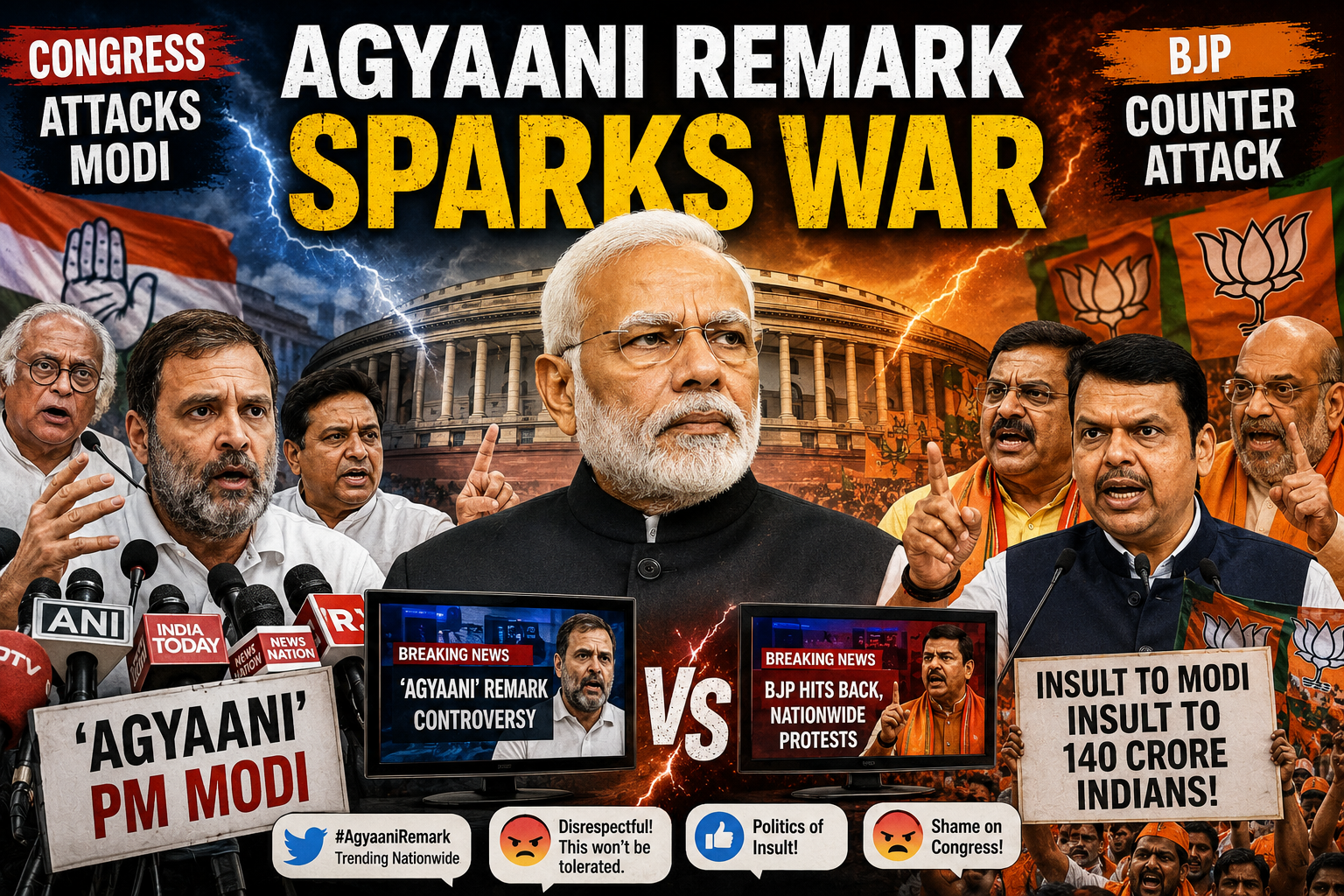
The description of Prime Minister Narendra Modi as “Agyaani” by Congress leaders has triggered a fierce political confrontation, with the BJP accusing the opposition of insulting not only the Prime Minister but also the mandate of millions of voters.
What began as a political remark has evolved into a nationwide campaign, media debate, and social media battle.
What Happened
The controversy erupted after Congress leaders used the term “Agyaani” while criticizing the Prime Minister’s policies and public statements.
The BJP responded sharply, accusing Congress of repeatedly resorting to personal attacks instead of engaging in policy debates.
Party leaders organized protests, press conferences, and public outreach campaigns across multiple states. BJP spokespersons framed the issue as evidence of what they described as the opposition’s arrogance and disconnect from public sentiment.
Congress leaders, meanwhile, argued that criticism of leadership decisions should not be confused with personal hostility and defended their right to challenge the government’s performance.
Background
Political rhetoric has long been a feature of Indian democracy.
From “Chowkidar Chor Hai” to “Pappu,” political parties have frequently used labels and slogans to shape public perceptions of opponents.
However, the growing influence of television debates, digital media, and social media algorithms has amplified the impact of such remarks.
What might once have remained a limited political exchange can now dominate national discourse within hours.
The BJP’s political machinery has historically demonstrated an ability to transform opposition attacks into mobilization campaigns, while the Congress has often argued that strong criticism is necessary to challenge powerful incumbents.
Why It Matters
The significance of this controversy extends beyond a single political insult.
For citizens, it raises questions about the quality of political discourse and whether substantive issues are being overshadowed by personality-driven conflicts.
For governance, it reflects how political energy is increasingly spent managing narratives rather than discussing policy outcomes.
For political parties, controversies like this offer opportunities to mobilize supporters, dominate news cycles, and reinforce ideological identities.
For society, the episode highlights the growing emotional nature of political engagement, where symbolism often carries as much weight as policy.
Analysis
The most important story here is not the word itself.
The real story is how political communication works in modern India.
The BJP has repeatedly shown an ability to convert criticism of Narendra Modi into broader political messaging. By portraying attacks on Modi as attacks on ordinary voters, the party strengthens emotional connections with its support base.
Congress faces a strategic dilemma.
Aggressive attacks generate media attention but can also provide political ammunition to opponents. The challenge for the opposition is ensuring that criticism remains focused on governance, economics, employment, inflation, or policy outcomes rather than becoming trapped in personality-centered disputes.
This controversy also reflects a broader global trend where political narratives increasingly revolve around identity, symbolism, and emotion.
Political parties understand that outrage travels faster than policy papers.
As a result, a single remark can generate more national attention than a lengthy debate on unemployment, healthcare, education, or economic reforms.
The larger governance lesson is clear: in the digital age, controlling the narrative can be nearly as important as controlling the policy agenda.
POLITICAL IMPACT
The immediate beneficiary may be the BJP, which has successfully shifted attention toward political rhetoric and party unity.
However, the controversy also provides Congress with another opportunity to highlight its criticism of the government and keep political pressure on the ruling establishment.
The long-term impact will depend on whether the debate remains focused on personalities or returns to substantive governance issues.
Conclusion
The ‘Agyaani’ controversy demonstrates how modern politics is increasingly fought through narratives rather than legislation.
While the immediate headlines focus on who said what, the deeper story is how political parties use language, symbolism, and public emotion to shape electoral battles.
The bigger question is not whether the remark was appropriate, but whether Indian politics can move beyond rhetorical wars and return to a debate centered on governance, accountability, and public policy.
With AI inputs