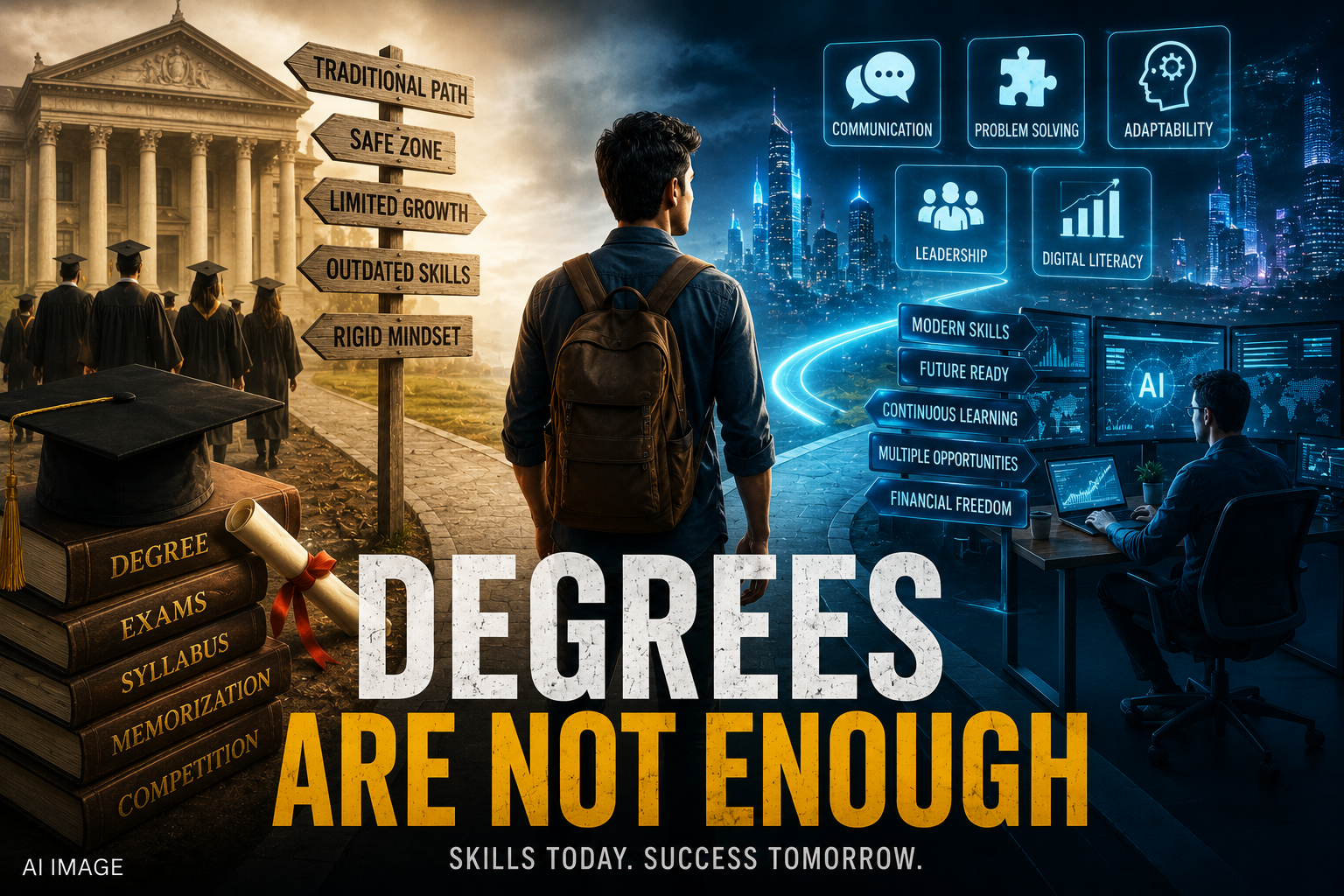
For generations, career advice followed a familiar formula:
Study hard, earn a degree, find a stable job.
That formula is not disappearing, but it is changing.
Artificial intelligence, automation, remote work, and rapidly evolving industries are forcing employers to rethink what they value most in employees.
The result is a growing focus on skills that cannot be easily automated.
For students and young professionals, the question is becoming increasingly important:
What skills will still matter when technology becomes even more capable?
What Happened
Recent reports from global employers, workforce researchers, and international organizations suggest that skill requirements are evolving rapidly.
While technical expertise remains important, employers increasingly emphasize adaptability, communication, critical thinking, leadership, and continuous learning.
The trend reflects a workplace where knowledge can become outdated quickly and where employees are expected to learn throughout their careers.
Background
Historically, degrees served as the primary signal of employability.
They still matter in many professions, particularly medicine, law, engineering, and specialized technical fields.
However, digital tools and online learning have expanded access to knowledge.
As a result, employers are increasingly evaluating what candidates can actually do rather than focusing exclusively on formal qualifications.
This does not mean degrees are becoming irrelevant.
It means degrees are increasingly becoming the starting point rather than the finish line.
Why It Matters
For students, understanding this shift can influence education and career decisions.
For employers, skills-based hiring may help address talent shortages.
For economies, a workforce capable of continuous learning is better positioned to adapt to technological change.
For society, the transition raises important questions about education systems and workforce preparation.
The challenge is no longer simply obtaining knowledge.
It is applying knowledge effectively in changing environments.
Analysis
Skill #1: Communication
AI can generate information.
It cannot easily replace trust.
People who can explain ideas clearly, persuade others, negotiate, and build relationships are likely to remain valuable across industries.
Skill #2: Problem Solving
Many future jobs will involve solving new problems rather than repeating routine tasks.
Employers increasingly value individuals who can identify issues, evaluate options, and make sound decisions.
Skill #3: Adaptability
Technology is changing faster than many traditional career paths.
The ability to learn new tools, adjust to new environments, and remain flexible may become one of the most important professional assets.
Skill #4: Leadership
Leadership is not limited to managers.
People who can coordinate teams, take initiative, and guide projects often create value regardless of their position.
Skill #5: Digital Literacy
Not everyone needs to become a programmer.
However, understanding digital tools, data, AI systems, and online workflows is increasingly becoming a baseline requirement across professions.
The Hidden Skill: Learning How to Learn
The most important future skill may be the ability to acquire new skills.
The careers of the future are unlikely to follow a straight line.
People who continuously upgrade their knowledge may have a significant advantage over those who rely solely on what they learned years earlier.
Conclusion
The future job market is unlikely to reward qualifications alone.
Degrees will continue to matter, but they will increasingly be accompanied by a broader set of practical abilities.
The young professionals most likely to succeed may not be those with the most certificates.
They may be those who combine education with communication, adaptability, problem-solving, leadership, and continuous learning.
In a rapidly changing world, the ability to learn may become the most valuable qualification of all.
With AI inputs