For nearly a century, the FIFA World Cup has been football’s ultimate stage.
But the 2026 edition represents something far bigger than a routine expansion.
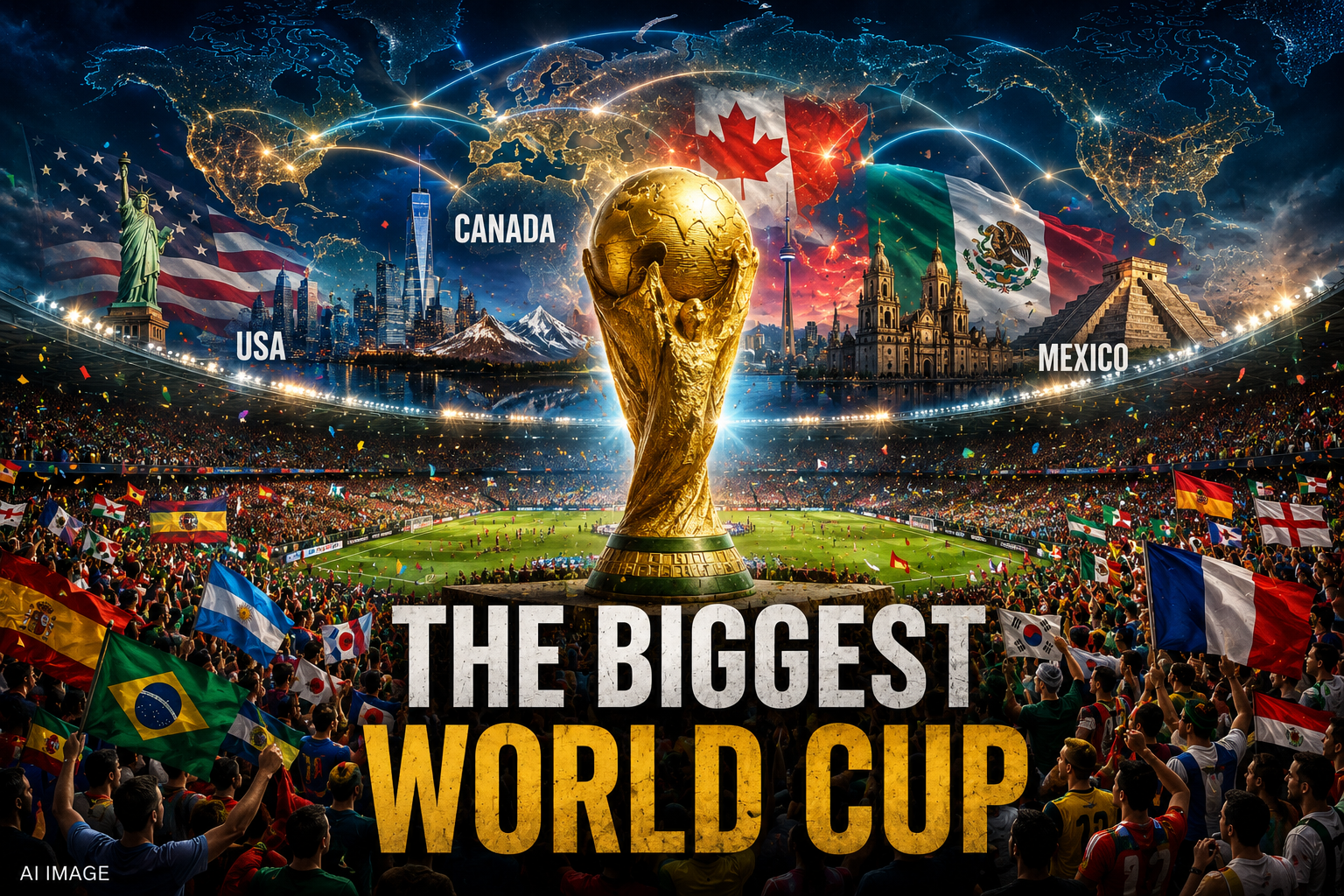
The tournament will be the largest World Cup ever held, bringing together 48 national teams across three host countries and significantly increasing the number of matches played. According to FIFA, the competition marks several historic firsts and could become a turning point for the global game.
The question is not whether FIFA 2026 will be bigger.
The real question is whether bigger will also mean better.
What Happened
The FIFA World Cup 2026 will be jointly hosted by the United States, Canada and Mexico, making it the first World Cup hosted by three countries. It will also be the first edition featuring 48 teams rather than 32.
Under the new format, teams are divided into 12 groups of four. The top two teams from each group, along with the eight best third-placed teams, advance to a Round of 32. This means the eventual champion will need to win eight matches instead of seven.
FIFA has also confirmed record financial distributions approaching USD 900 million for participating national associations.
Background
The World Cup has undergone several expansions throughout its history.
The tournament featured 24 teams between 1982 and 1994 before expanding to 32 teams in 1998.
The move to 48 teams is FIFA’s biggest structural change in decades. Supporters argue it creates opportunities for emerging football nations and increases global participation. Critics, however, worry that expanding the field could dilute competitive quality and place additional demands on players.
The expansion has already opened the door for several countries that might previously have struggled to qualify for the tournament. FIFA’s qualification process has produced one of the most geographically diverse World Cup fields in history.
Why It Matters
The impact extends well beyond football.
For fans, the expanded tournament means more matches, more countries and greater representation from regions historically underrepresented at the World Cup.
For participating nations, qualification brings prestige, tourism opportunities and significant financial benefits.
For businesses, broadcasters and sponsors, the tournament represents one of the largest sporting audiences on Earth.
For host countries, the event is expected to generate billions in economic activity through tourism, hospitality, infrastructure spending and global exposure.
For football itself, FIFA 2026 serves as a test of whether expansion can increase inclusivity without reducing competitiveness.
Analysis
The most important story behind FIFA 2026 is not the number of teams.
It is FIFA’s broader vision for globalization.
For decades, football’s biggest prizes were dominated by a relatively small group of nations from Europe and South America.
The expanded World Cup reflects a strategic shift toward growing the sport in Asia, Africa, North America and smaller football markets.
From a business perspective, the move is easy to understand.
More teams create more television markets.
More markets create larger audiences.
Larger audiences create greater sponsorship and broadcasting revenues.
The challenge is sporting quality.
Historically, major tournament expansions have produced mixed results. While they create opportunities for emerging nations, they can also produce uneven matches during the early stages.
Yet there is another perspective.
Many countries once considered football outsiders eventually became competitive powers after repeated exposure to elite tournaments.
Croatia, Morocco, South Korea and others demonstrate how international football can evolve over time.
The long-term success of the 48-team format will therefore be measured not by attendance figures or revenues alone, but by whether new football nations become genuine competitors in future tournaments.
MARKET IMPACT
FIFA has approved a record financial distribution package approaching USD 900 million for participating associations, highlighting the commercial scale of the tournament. The World Cup remains one of the world’s most valuable sporting properties and is expected to attract enormous advertising, sponsorship and broadcasting investment.
Conclusion
The FIFA World Cup 2026 will be remembered for its scale.
Three host nations.
Forty-eight teams.
Record revenues.
But the tournament’s true legacy may lie elsewhere.
If the expanded format helps create new football powers and broadens the sport’s global reach, FIFA 2026 could become one of the most consequential World Cups in history.
If not, it may simply be remembered as the tournament that became bigger without becoming better.
With AI inputs