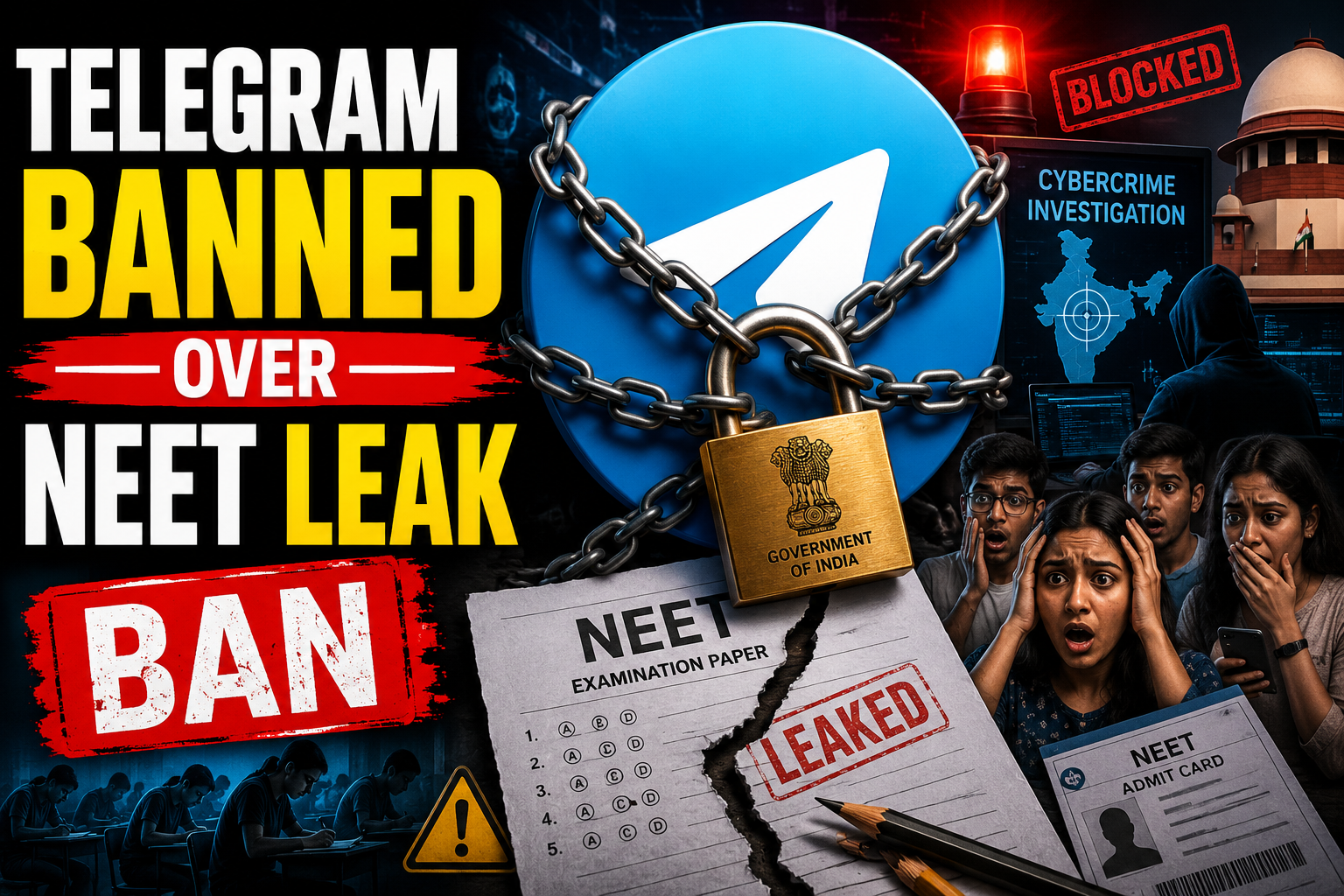
In June 2026, India’s education authorities took the extraordinary step of temporarily blocking Telegram ahead of the re-examination of NEET-UG (the national medical entrance test). The government said this was needed to thwart organised “paper leak” scams. Telegram was ordered offline nationwide from June 16–22 under Section 69A of the IT Act, and its message-edit feature was disabled until June 30. Officials, including NTA Director-General Abhishek Singh, described it as a “last resort” after fraudsters exploited Telegram channels to sell fake exam papers for hefty sums. Telegram’s founder and digital-rights groups criticized the ban as “rash” and disproportionate, since it impacts the app’s 150 million users in India rather than just the scammers. Opposition leaders also attacked the move: Congress’s Rahul Gandhi likened it to locking out victims instead of catching thieves. This analysis unpacks the facts, official reasoning and legal basis for the ban, its impact on students and policy debates, and the remaining open questions.
What Happened
In early May 2026, India’s National Testing Agency (NTA) cancelled the NEET-UG exam held on May 3 after a leak was confirmed. A coaching hostel owner in Sikar (Rajasthan) had tipped off authorities when students received a 410-question “question bank” just before the test. The CBI took over the inquiry, arresting school and coaching personnel accused of selling advance access to exam materials. With 2.27 million candidates affected, the NTA scheduled a full re-examination for June 21.
In the ensuing weeks, authorities noticed a new wave of scams exploiting student fears. Cybercrime units and the Ministry of Electronics & IT found hundreds of Telegram channels and groups openly offering to sell the forthcoming NEET paper (in reality non-existent) for prices ranging from a few thousand rupees up to ₹10 lakh. These channels had names like “PAPER LEAKED NEET”, “Re-NEET 2026” or “Private Mafia”. Even after the exam was over, channel admins quietly edited old posts to insert real exam questions, creating the illusion they had predicted the paper. In response, on June 16 the Government of India restricted Telegram countrywide until June 22, on the recommendation of the NTA. Google promptly removed Telegram from its Play Store, and Apple complied with the directive. Telegram’s founder Pavel Durov criticized the move on social media, saying it “punishes 150M+ ordinary users” and noting that “the leaks just moved to other apps”.
The NTA and IT Ministry defended the action as necessary for public order and exam integrity. “We had to take this drastic step because the platform was continuously being misused by scamsters,” NTA chief Abhishek Singh told news agencies. He emphasized that no legitimate leak existed for the June 21 re-test; every promise of an early paper was a fraud. Key Telegram channels were also subject to takedown efforts by the Indian Cyber Crime Coordination Centre (I4C) and state police (in Bihar, Gujarat and Rajasthan), but new ones kept appearing. With a tight exam schedule approaching, the govt concluded only a broad ban — plus disabling Telegram’s message-editing feature through June 30 — could stamp out the fake-paper networks.
Background
NEET-UG (National Eligibility-cum-Entrance Test) is India’s singular national exam for medical and dental college admissions. Over 22 lakh students register each year; this year’s May 3 exam was cancelled due to a grave security breach. The leak scandal has shaken public confidence. Students nationwide have protested and politicians have called for accountability. After cancelling the exam, the NTA swiftly announced a full re-examination on June 21, 2026. In preparation, governments at both Centre and state level mobilized security: Army personnel were put on standby, mobile jammers and CCTV were readied, and exam centers would use frisking and police escorts. In Assam, for example, the chief minister mandated double-layer frisking, police guards, mobile jammers and secure courier delivery for question papers. Similar “no loophole” pledges came from many states. The nationwide Telegram ban fits into this flurry of measures meant to reassure students and parents that the upcoming NEET re-test will be fair and leak-free.
Meanwhile, Telegram’s popularity in India — with over 150 million users — explains why it became a focus. Many students use Telegram groups for study materials. But Telegram’s unique editing feature gave fraudsters a powerful tool: they could post a dummy message before the exam, then edit it afterward to include real questions, making it look like a genuine leaked paper. The NTA identified this as a “specific concern” and insisted temporarily disabling editing worldwide. This technical detail (which doesn’t exist on WhatsApp) has drawn interest: experts note that under Telegram’s rules, channel admins can edit messages without time limit, and subscribers only see the final content with a small “edited” tag. This loophole had never before caused such a major policy action, highlighting how exam fraudsters adapt to technology.
Why It Matters
The Telegram ban has direct impact on millions of people. Approximately 22.7 lakh NEET aspirants have their futures on the line; any hint of malpractice undermines trust in one of India’s most important exams. Many students and parents have felt vulnerable and anxious; official security and communication measures aim to calm that. Blocking Telegram signals that the government will use all tools to protect the process.
At the same time, by shutting down a widely used app, the move sparked outcry about individual rights vs. collective security. Unlike a localized lockdown of a specific chat group, this is a nationwide measure affecting ordinary citizens. Telegram has legitimate uses for study and free speech; critics note that the ban “punishes 150M+ ordinary users” while criminals may simply move to other platforms. In practical terms, users scrambled to install VPNs and alternative apps. Tech-savvy students expressed annoyance, asking why WhatsApp or other apps weren’t similarly blocked if exam papers could be shared there. The government’s choice of Telegram specifically — after failing to get cooperation from Telegram’s officials on takedowns and logs — makes this case a flashpoint in broader debates over online censorship and proportionality under law.
On the education front, the episode underscores systemic issues. A test-driven culture with immense stakes has given rise to a “mafia” of cheats, as even Prime Minister Narendra Modi once put it. The Telangana scam is not new; NEET has faced leaks or unfair advantage claims before. The difference now is technology: encrypted messaging and social media amplify how quickly rumors or fake materials can spread. Parents are worried about being duped or having to verify every claim. Administrators worry about handling legitimate queries versus malicious rumors. Finally, the incident carries political weight: parties use it to score points or demand reforms, but the underlying contest is about young students’ futures and faith in institutions.
Analysis
Policy and Legal Angle: India rarely blocks an entire platform over one issue. The government invoked Section 69A of the IT Act (under which the ban occurred) as an emergency power to act against threats to “public order.” Digital-rights groups, however, argue that 69A authorizes blocking specific harmful content, not an entire app. The Internet Freedom Foundation has pointed out that forcing Telegram to disable a feature may also exceed the law’s scope. If the High Court (where Telegram has challenged the ban) eventually rules against this broad use of 69A, it could set a precedent limiting such platform-level censorship. For now, the government says it had no choice after individual channel takedowns failed.
Technical Implications: The case brings a fresh “Governance lesson” in how tech features can be weaponized. Telegram’s edit function, intended to fix typos or update group posts, was ingeniously repurposed by cheats. Regulators globally will likely watch this incident as an example: app designers may need to build safeguards (e.g. marking edits more prominently, limiting backdating) when major events like exams are happening. It also shows law enforcement’s expanding focus on cyber fraud – agencies coordinated over weeks to flag scam channels and currencies (the ₹1.5 crore in transactions is now evidence). For exam administrators, it illustrates that exam security must now include digital monitoring, not just physical measures.
Political Angle: Opposition leaders seized on the ban to criticize the government’s approach. Rahul Gandhi’s viral “lock on victim’s door” jibe reflected frustration among students and students’ groups. Some state leaders have questioned why only Telegram was targeted. By contrast, many politicians from all parties also declared solidarity with students’ plight and affirmed that “the mafia” behind leaks would be crushed, without endorsing the ban specifically. Importantly, this issue has not hardened traditional party lines; it’s more about accountability and competence than ideology. The Centre’s stance has been to frame it as a neutral technical fix, but public debate has raised broader concerns about excessive control of the Internet for narrow objectives.
Larger Trend: This incident is part of a trend where governments experiment with internet controls to enforce real-world rules. It’s reminiscent of past cases – for example, temporary bans on websites for communal violence content. The technology-policy community will scrutinize whether punishing millions for the actions of a few is effective or if it simply drives bad actors underground. Telegram’s CEO claimed the leaks simply moved to other apps (some reports noted channels popping up on WhatsApp and private forums). In other words, critics say, the ban is a stopgap, not a root-cause solution. Meanwhile, educational authorities may consider changes to exam systems (multiple question paper sets, more randomization, fully digital management) to reduce the gains of leaks.
Unanswered Questions: Several verification gaps remain. Will the Delhi High Court expedite Telegram’s plea and possibly lift the ban? Will any high-level inquiry scrutinize NTA’s cancellation decision or demand transparency on how leaks occur? While NTA officials deny any new leak prompted the ban, some candidates might still worry that insiders leaked the exam (the Telecom minister mentioned “non-responsiveness” by Telegram regarding the original May 3 leak probe). The government has blamed “unscrupulous individuals”, but those individuals’ identities and accountability in the May leak are still under investigation by the CBI. The Telegram ban episode adds a new twist to the story – it shows how even unverified rumors can force policy moves.
Investigation Status
Several investigations are ongoing. For the original NEET paper leak (May 2026), the CBI leads the inquiry and has arrested multiple suspects (teachers, coaching centre operators) charging them under the IPC and Prevention of Corruption Act. The re-exam fraud ring is being handled by state cybercrime units. In Ahmedabad, police arrested two Rajasthan residents (Sumer and Akash Meena) for running eight Telegram channels selling fake papers. In Bihar’s Muzaffarpur, four people were arrested for selling fake exam papers via social media, and another man was caught siphoning students’ refund money (after May’s cancellation). The I4C (cybercrime coordination cell) has coordinated takedowns of numerous fraudulent channels.
Meanwhile, Telegram itself has challenged the ban in Delhi High Court. The case was slated for urgent hearing on June 17, 2026. Telegram’s lawyers argue the directive is arbitrary and unscientific; the government will argue it’s within its emergency powers. No court order has been issued yet, and the ban remained in effect through June 22 as scheduled.
On the exam front, the NTA has insisted it will conduct the June 21 re-test “without any malpractice”. It issued admit cards on June 14 and asked all candidates to verify their bank accounts for the promised fee refund. State governments have deployed armed guards, GPS-monitored paper transport, and tech measures (jammers, CCTV) for the exam. Observers will watch both the conduct of the exam (on June 21) and the courts’ handling of the Telegram case.
Conclusion
With NEET’s high stakes, the Telegram ban reflects an aggressive, if controversial, approach to ensuring exam integrity. Authorities insist it was a necessary, temporary fix: “We will not let anything go wrong,” NTA’s chief said. If the measures work (no new leaks, a smooth re-exam), the government will likely claim vindication. If problems surface, critics will point to the blanket ban as misdirection. For students and parents, the immediate priority is the exam itself: getting a fair chance at their future. The long-term lesson will be about balancing exam security with legal norms and digital freedoms.
The biggest question—how to stop exam fraud at its roots—remains open. The Bureau Report will continue following official updates: the outcome of the NEET re-test on June 21, any court ruling on Telegram, and the final conclusions of ongoing probes. For now, aspiring doctors are focusing on their studies and hoping the paperwork does not trip them up.
With AI inputs.