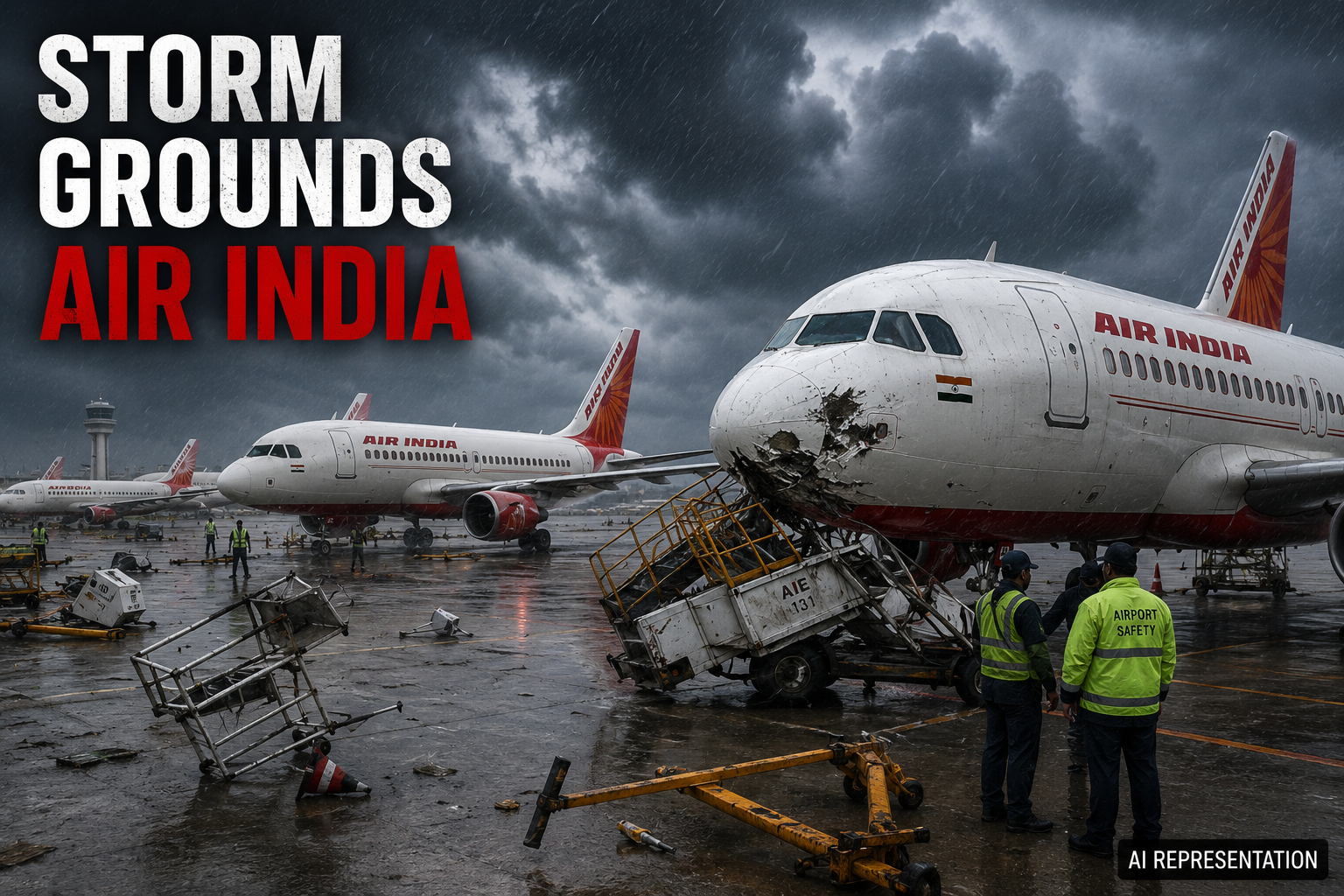
A sudden storm at Delhi’s Indira Gandhi International Airport (IGIA) has damaged three parked Air India aircraft, creating operational disruptions and raising broader questions about airport ground safety. The incident occurred near Terminal 2 when powerful winds reportedly displaced ground-support equipment, which then collided with parked aircraft. No injuries were reported.
What Happened
According to airport and airline sources cited in multiple reports, strong winds and heavy rain swept across the airport on Sunday evening. During the weather event, ground-support equipment positioned near aircraft parking bays was reportedly blown or displaced from its location and struck three parked Air India aircraft.
The affected aircraft were reported to be Air India A320 family aircraft parked near Terminal 2. Sources indicated that equipment involved included a trestle and a step ladder associated with engineering and maintenance operations. Airport authorities subsequently removed all three aircraft from service for inspections and repairs.
One aircraft reportedly sustained more extensive damage and may remain grounded for several days, while the other two are expected to return to service after inspections and repairs. However, authorities have not yet released a detailed technical assessment of the damage.
Background
Airports use a large range of ground-support equipment—including stairs, ladders, trolleys, trestles, and maintenance platforms—to service aircraft between flights. During severe weather, these assets must be secured to prevent movement that could endanger aircraft, personnel, or airport infrastructure.
While weather-related flight delays are common, incidents involving ground equipment striking aircraft are comparatively rare and often lead to detailed operational reviews because they can reveal vulnerabilities in airport safety procedures.
Why It Matters
The incident is significant because it occurred on the ground rather than in the air. Aviation safety discussions frequently focus on pilots and aircraft systems, but airport apron operations are equally critical.
For passengers, damaged aircraft can lead to flight delays, schedule disruptions, and reduced fleet availability. For airlines, even minor structural damage may require extensive inspections before an aircraft can safely return to service. For airport operators, the incident highlights the challenge of managing sudden weather changes in highly congested operational environments.
The financial impact may also extend beyond repair costs, affecting aircraft utilization, scheduling, and maintenance planning.
Analysis
The most important question arising from this incident is not whether a storm occurred, but whether airport systems were adequately prepared for it.
Multiple reports quote airport and airline sources as claiming that no prior weather warning was received before the sudden deterioration in conditions. However, this claim has not been independently verified by aviation regulators or weather authorities and should therefore be treated as an allegation rather than an established fact.
A second issue concerns ground-equipment management. Even if the weather event was sudden, investigators and airport authorities may examine whether securing procedures were sufficient for extreme wind conditions.
The incident also follows another notable Air India ground-safety event earlier this year, when an Airbus A350 aircraft suffered engine damage after ingesting a cargo container while taxiing at Delhi airport. Although the two incidents are unrelated, both draw attention to risks associated with ground handling and apron operations rather than aircraft performance in flight.
From a policy perspective, India’s rapidly growing aviation sector may increasingly need to focus on resilience against sudden weather events, particularly as airports handle higher traffic volumes and more complex ground operations.
INVESTIGATION STATUS
As of publication, no official investigation findings have been released. Authorities are assessing the damage and reviewing the circumstances surrounding the incident. Reports indicate that all affected aircraft have been removed from service pending inspections and repairs.
Conclusion
The immediate outcome was relatively fortunate: no injuries were reported and the aircraft were parked at the time of the incident. However, the event raises a larger operational question for India’s aviation sector—whether existing ground-safety and weather-response procedures are adequate for increasingly unpredictable weather conditions. The answer will depend on the findings of subsequent reviews and technical assessments.
With AI inputs.