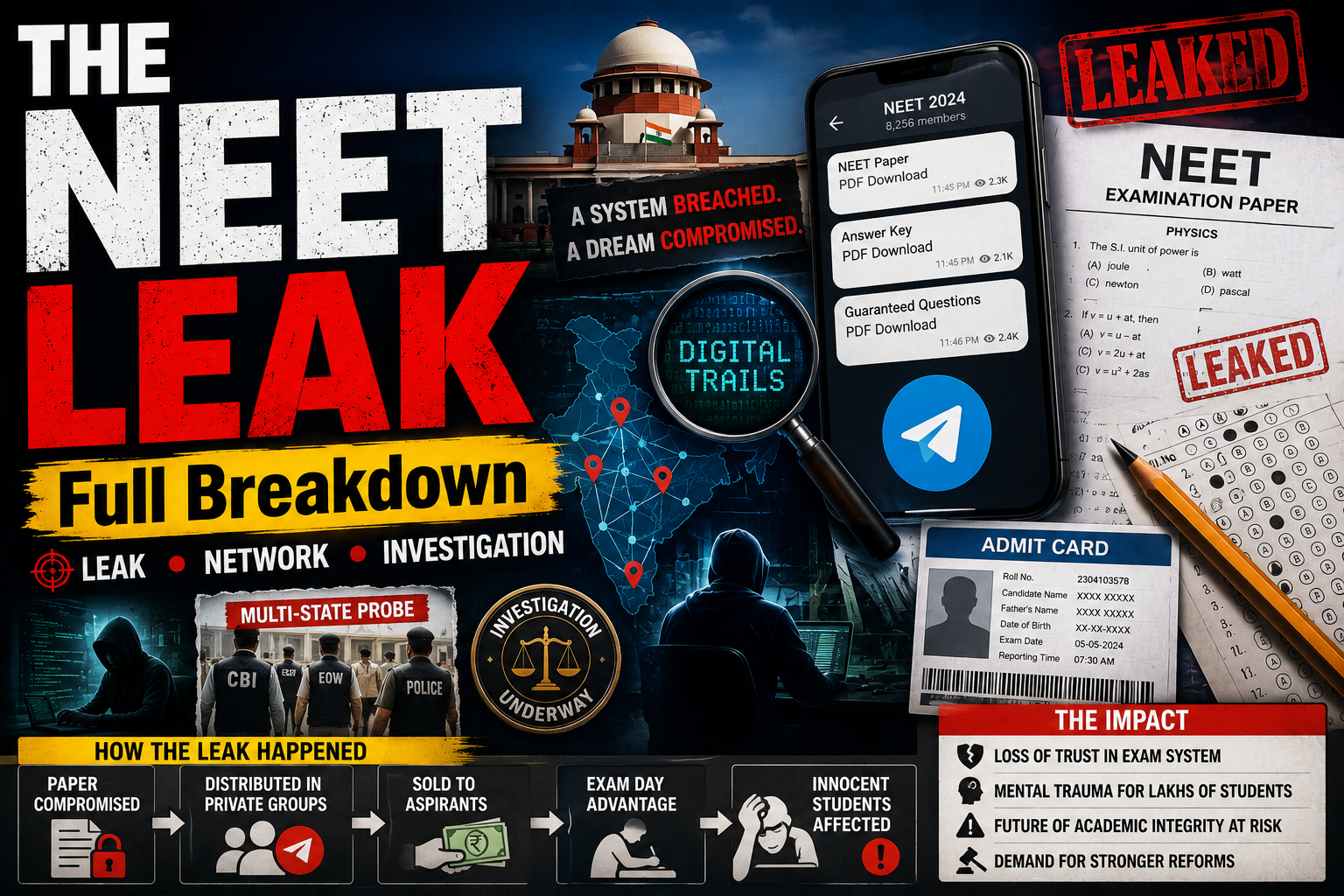
India’s prestigious NEET (UG) medical entrance test, taken by over 22 lakh candidates in May 2026, has become embroiled in a major scandal. Within days after the exam, teachers and students alerted authorities that a “guess paper” circulating in coaching circles bore an uncanny resemblance to the official NEET question paper. The National Testing Agency (NTA) ultimately cancelled the May 3 exam. In a rare move, the government even ordered a temporary ban on Telegram – a global messaging platform – to prevent further fraudulent “paper leak” claims ahead of the rescheduled exam.
This article examines what happened, why it matters, and the wider context. We detail the timeline of events, the official and independent investigations, and the impact on students and the education system. We also analyze emerging lessons: the security vulnerabilities laid bare by this leak, how exam authorities are responding (from arrests to tech restrictions), and the policy debates it has reignited.
What Happened
Timeline of Events (NEET-UG 2026 Paper Leak):
| Date/Time | Event |
|---|---|
| 2 May 2026, 11:00 PM (approx.) | A NEET aspirant studying away from home (in Kerala) reportedly sends a “guess paper” PDF to his father, a hostel owner in Sikar, Rajasthan. |
| 3 May 2026 (Exam Day) | The NEET (UG) 2026 exam is conducted nationwide. |
| 3 May 2026, ~2:00 PM | About two hours after the exam ended, a coaching institute teacher in Sikar (Rajat*) reviews the “guess papers” shown to him by a student. He notes a large overlap with the actual exam (over 135 matching questions). |
| 3 May 2026, 9:00 PM | The teacher confirms the leak: 45 of 45 Chemistry questions and 90 of 90 Biology questions in the viral PDFs match the exam paper. |
| 4–6 May 2026 | News spreads quietly among coaching networks. Suspicions grow as more students discuss the leaked “question bank.” |
| 7 May 2026 | Whistleblower complaint: The Rajasthan teacher and student email the NTA (with proof) via a state official. Meanwhile, “Private Mafia” and other WhatsApp/Telegram groups are found circulating 100+ questions that overlap with the NEET paper. |
| 8 May 2026 | The NTA formally refers the case to central investigators. Multiple agencies (Rajasthan Police SOG, cyber units, etc.) begin examining seized devices and chat records. |
| 10 May 2026 | Rajasthan Police’s Special Operations Group (SOG) launches an official FIR. By May 12, at least 13 people have been arrested (mostly in Rajasthan) in connection with the leak. Names include suspected “middlemen” from coaching hubs (e.g. Sikar, Jaipur) and an accused Nashik counsellor (Shubham Khairnar). |
| 12 May 2026 | Exam cancelled: The NTA, with Central Government approval, announces cancellation of the May 3 NEET-UG exam. A CBI probe is launched under sections of the Prevention of Unfair Means Act and criminal conspiracy. The NTA vows to reschedule the exam and refund fees. |
| 15 May 2026 | Re-exam announced: The NTA issues an official notice scheduling the NEET re-test on June 21, 2026. Candidates are assured no fresh registration or fee is needed; existing exam centres remain. Fresh admit cards will be issued. |
| 16–22 June 2026 | Telegram ban: Acting on NTA’s recommendation, the Ministry of Electronics & IT orders a temporary block on Telegram in India (June 16–22) and requires Telegram to disable its message-edit feature until June 30. The aim is to stop fake “leak” posts circulating after the exam. Students are warned to rely only on official NTA channels for updates. |
| 21 June 2026 | NEET Re-exam: The revised NEET-UG 2026 exam is conducted under heightened security (CCTV, jammers, increased police escort). |
*Times based on media reports (exact clock times are illustrative).
These events were pieced together from official notices and media accounts. The HL timeline above shows how a leaked “question bank” (a PDF circulated in Telegram/WhatsApp groups) triggered the chain reaction. The father of a medical student in Sikar – also a hostel keeper – first raised alarm on May 3, and by May 7 the NTA was formally alerted. The leak was confirmed when educators compared the viral PDF to the actual test and found dozens of identical questions.
Several agencies (state police and the CBI) then worked jointly. By mid-May, nine suspects had been arrested across multiple states. Notably, the CBI has detained two NTA-appointed paper-setters (Professors Manisha Mandhare and P.V. Kulkarni, who had access to parts of the exam) and several counsellors and facilitators. The Times of India and Hindustan Times confirm these arrests and ongoing searches in Pune, Nashik, Latur, Jaipur, and elsewhere. Investigators describe a syndicate spanning Rajasthan, Haryana and Maharashtra, in which the original question paper was allegedly procured and then resold to others.
Background
NEET (UG) is India’s mandatory national entrance exam for admission to MBBS/BDS medical colleges, including AIIMS and JIPMER since 2019. It is conducted annually by the National Testing Agency (NTA) in offline (pen-and-paper) mode at over 7,500 centres nationwide. More than 22 million applicants registered for NEET-UG 2026. Given this scale and the high stakes, exam security is always a critical concern.
This is not the first NEET controversy. In 2024, a minor leak and resulting protests led to extra safeguards (like tougher questions) but no full cancellation. Indian courts and governments have long resisted re-tests without conclusive evidence. For example, during the 2024 NEET leak claims, the Supreme Court and government insisted that the exam still be held, arguing that a full-scale breach had not been proven. By contrast, in 2026 the evidence – as gathered by Rajasthan police and CBI – convinced authorities that integrity was irreparably compromised.
The NTA itself has a short history (established 2017), and some reports note its limited resources: at the time of the 2024 issue it had around two dozen deputed officers plus a couple hundred contractual or outsourced staff. That understaffing raised long-term questions about whether the agency can police huge exams. Meanwhile, “paper leaks” have plagued many Indian tests (e.g. staff selection exams, police exams, state tests, etc.), creating a trust deficit. NEET is no exception: offline paper-based tests can be vulnerable at multiple stages (printing, transport, centre storage).
The 2026 case was aggravated by the rise of encrypted messaging apps. Fraudsters can now coordinate across state lines on WhatsApp and Telegram, demanding large sums for “guaranteed” Q&A banks. In fact, officials say no legitimate exam question exists outside official channels, and any such offer is fraudulent. Nonetheless, the scale of the NEET exam and the financial incentive (tens of thousands of rupees per student) have bred sophisticated cheating rackets.
Why It Matters
The fallout of this leak goes beyond one cancelled test:
- Students and Parents: Over 22 lakh NEET candidates (and their families) face anxiety, lost study time, and postponed college admissions. Many spent two years preparing under stressful conditions; the sudden cancellation disrupted plans (some had planned alternative career options assuming exam results). Student groups across India have protested for clarity and swift resolution. The uncertainty about new dates and results compounds their stress.
- Trust in the System: For a nationally competitive exam, perceived fairness is vital. Repeated leaks erode confidence in the testing system and the NTA. If students believe “money and contacts” determine success, public outrage grows. This incident has especially revived calls for structural reforms (see Analysis).
- Governance and Policy: The government must balance swift action with protecting citizens’ rights. The Telegram block is an extraordinary measure (more below) — it shows how exam security can clash with digital freedom debates. Critics note that addressing leaks by banning platforms sets a precedent for controlling online content. Authorities argue it is temporary and narrowly tailored to protect public order during a critical period.
- Economic Impact: The NEET exam market (tuition centres, publishers, coaching hubs) is worth crores of rupees. A major leak can destabilize this ecosystem. Coaching businesses that sell “guess papers” for profit face scrutiny. Meanwhile, legitimate ed-tech and coaching firms may demand reforms to restore fairness so students feel their investment (tuition fees, study materials) is not wasted by corruption.
- Social and Ethical: Cases like this amplify concerns about corruption in education. They spark debates on meritocracy vs. money in Indian society. Further, if exam centers are perceived as unsafe or unreliable, it could drive more demand for private tuitions, increasing inequality (only those who can pay large bribes or tuition “packages” might succeed).
In short, the leak is not just an academic scandal – it has real implications for millions of young Indians, the medical profession, and trust in public institutions.
Analysis
A key lesson from the NEET-UG 2026 scandal is that narrative and perception can shape policy as much as facts. The substantive issue – question-paper security – became embroiled in heated public debate, forcing swift administrative and even legal reactions.
Inside the Network: Media reports (later confirmed by police) indicate an organized, multi-tier network. At the top, insiders on the exam-setter panel are accused of leaking portions of the paper. These insiders allegedly supplied the paper to “middlemen” (e.g. coaching consultants or counsellors like Shubham Khairnar) who then sold printed copies to students or fellow coaches. The leak chain reportedly ran through states: from Maharashtra (Nashik/Pune) and Haryana into Rajasthan hubs like Sikar, and even Kerala (where the student originally found the PDF).
Such an operation exploits several vulnerabilities: human greed and collusion (the paper setters and touts), delays in centralized detection, and the power of encrypted communications. Fraudsters capitalized on Telegram’s features (private channels, large broadcast reach, and message editing) to appear credible. For example, channels would post innocuous messages before the exam and then edit them after the fact to insert the actual paper, making it look like they had the paper in advance. This tactic misled naive aspirants into thinking the leak was proven.
Technology vs. Tradition: The government’s response highlights the tech dimension. Banning Telegram is an unusual step that signals how digital platforms have become entwined with exam security. In a country grappling with online misinformation and privacy concerns, this move is controversial. Supporters say it was a “minimum necessary restriction” to maintain public order during the exam window. They note that the block was time-bound (15 Jun–22 Jun) and targeted only one app, not all messaging services. Critics argue it may violate net neutrality or could be misused later.
More broadly, the incident has fueled debates on digitizing the exam process itself. Many experts now call for phasing NEET (and possibly other large exams) into a computer-based test (CBT) format. As one report notes, “Future NEET-UG exams will adopt computer-based testing to enhance security”. While details are sparse, online exams could mitigate paper-leak risks (if done with secure browser environments, randomized Q-banks, etc.). However, CBT brings its own challenges (digital infrastructure, unequal computer access, hacking risks).
Institutional Accountability: Politically, the contesting narratives are predictable. Government authorities emphasize that investigations are underway and that they acted to protect students’ interests. Opposition figures and student activists highlight repeated failures and demand accountability. For example, the Federation of All India Medical Association (FAIMA) has petitioned the Supreme Court to “restructure or replace” the NTA and hold a judiciary-supervised re-examination. Whether the courts will intervene or defer to executive action remains to be seen.
Global and Historical Parallels: India’s exam leak crisis mirrors trends worldwide: high-stakes tests are often targets for fraud (from SAT cheating rings to Cambridge Analytica’s exam data hacks). The NEET scandal underlines that securing an exam is a systemic problem, not just about one-time vigilance. It requires robust design (e.g. multiple test versions, encryption, anti-tamper measures), constant monitoring (traceability of paper movements), and public transparency. Historically, India has faced exam scams (like the 2013 Vyapam scandal in Madhya Pradesh). Often, these episodes lead to incremental reforms, but recurring cases suggest deeper cultural issues in the admissions ecosystem.
Investigation Status
As of June 2026, the probe is ongoing under the CBI (Central Bureau of Investigation). The initial complaint was formally registered on May 12 after the Ministry of Education flagged the irregularities. Several FIRs have been filed under the Public Examinations (Prevention of Unfair Means) Act, 2024 (a law enacted to deter exactly this kind of fraud), as well as criminal conspiracy and evidence destruction provisions.
- Arrests: At least 13 people have been detained so far. These include two senior teachers (Manisha Mandhare and P.V. Kulkarni) from Pune and Latur who were on the NTA’s NEET paper-setting panel. They allegedly leaked sections of the question paper (biology and chemistry, respectively). Also arrested are Shubham Khairnar (Nashik “Dr.”), Dr. Manoj Shirure (Latur doctor), Tejas Shah (Pune coaching faculty), and a handful of local touts (the Biwal brothers in Rajasthan). Many of the suspects have been handed over to CBI custody for further questioning.
- Searches & Seizures: CBI teams have conducted raids across Maharashtra, Rajasthan, Delhi, and Gujarat. They report seizing digital evidence (laptops, phones with chat histories) and financial records (bank transactions). Forensic analysis of these devices is expected to map the full chain of distribution. The CBI says its teams have “traced the actual source of the leaked Physics, Chemistry, and Biology questions” used in the exam.
- Court Cases: Multiple court petitions are pending. The Supreme Court took cognizance of pleas both for judicial oversight of the re-exam and for broader reforms in exam conduct. (A bench on May 25 sought the NTA’s affidavit on measures taken.) No judgment has been issued yet. So far, all arrested persons remain in custody (typical for serious fraud under PEMA), and prosecutions are likely under way, though no trials have concluded.
- Official Statements: The NTA has repeatedly emphasized that the re-exam will proceed as scheduled (June 21) and that it is cooperating fully with law enforcement. The Agency’s director stressed that cancelling the exam was necessary to protect its credibility. Meanwhile, various state police forces (e.g. Gujarat, Bihar) have issued advisories cautioning students against “fake paper” offers. The Telegram ban itself came via MeitY (Ministry of Electronics & IT) on NTA’s recommendation.
The overall message from authorities is that the investigation is active and key figures are in custody. However, given the complexity, it is likely to continue for months. Several inquiries will also follow: departmental probes into how NTA’s processes were breached, and committee reports on exam security.
Comparison of Claims
| Issue/Claim | Official Statement | Media Coverage | Social Media Claims |
|---|---|---|---|
| Existence of leak | NTA: No NEET paper exists outside secured channels. Fraud rings are targeting students. | News: Investigators found 100+ leaked questions matching the exam. Teacher confirms ~135 Q matched. | Viral posts alleged full paper was leaked (exaggerating overlap). |
| Rescheduled exam date | NTA: Re-test set for June 21, 2026 with govt approval. Official exam centres retained. | Widely reported in press: Re-exam on June 21 (Times of India, NDTV). | Many rumors on messaging apps about alternate dates or multiple attempts. |
| Telegram restrictions | NTA/MeitY: Block Telegram (15–22 Jun) and disable edits (till Jun 30) “in interest of public order”. | Outlets note ban aimed at curbing exam fraud ahead of re-exam. Experts debate its scope. | Opponents call it censorship; trolls claim govt is “censoring” students. |
| Investigation progress | Govt: CBI probe underway, full cooperation. Departmental and police teams are tracing the crime network. | Reports detail multiple arrests (teachers, doctors, agents) and raids in 49 locations. | Conspiratorial posts claim everyone in NTA/Ministry is complicit (unverified). |
| Security reforms | NTA: Emphasizing tighter exam protocols. Possible shift to computer-based mode being considered. | Media quoting FAIMA and experts demanding overhauls (judicial oversight, new tech). | Some students demand exam be scrapped entirely or completely online – often lacking detail. |
Sources: NTA press releases and notices; news articles; public statements and social posts.
Conclusion
The NEET-UG 2026 paper leak has exposed deep vulnerabilities in India’s examination system. A seemingly routine online rumor about a “guess paper” cascaded into a national scandal, costing students time and faith in the system. It underscores that modern exam security must span physical, digital and human elements: from secure printing and transport to monitoring online platforms and punishing cyber-enabled fraud.
In response, authorities have taken unprecedented steps – from cancelling the exam to banning a major messaging app. The re-exam on June 21 will be closely watched as a test of these measures. But long-term lessons are more important. Policymakers may need to consider technological shifts (like computer-based testing) and stricter oversight of question-setting committees. They must also bolster the NTA’s capacity (both in staffing and expertise) and perhaps involve judicial or independent review for ultra-high-stakes exams.
Ultimately, the bigger question is whether educational administrators and regulators will learn from repeated breaches. Each leak corrodes students’ trust in meritocracy. For now, the immediate focus is on giving affected NEET candidates a fair chance through a secure re-exam. But the incident should also galvanize lasting reforms – or India risks facing the same scandal with next year’s test.
With AI inputs