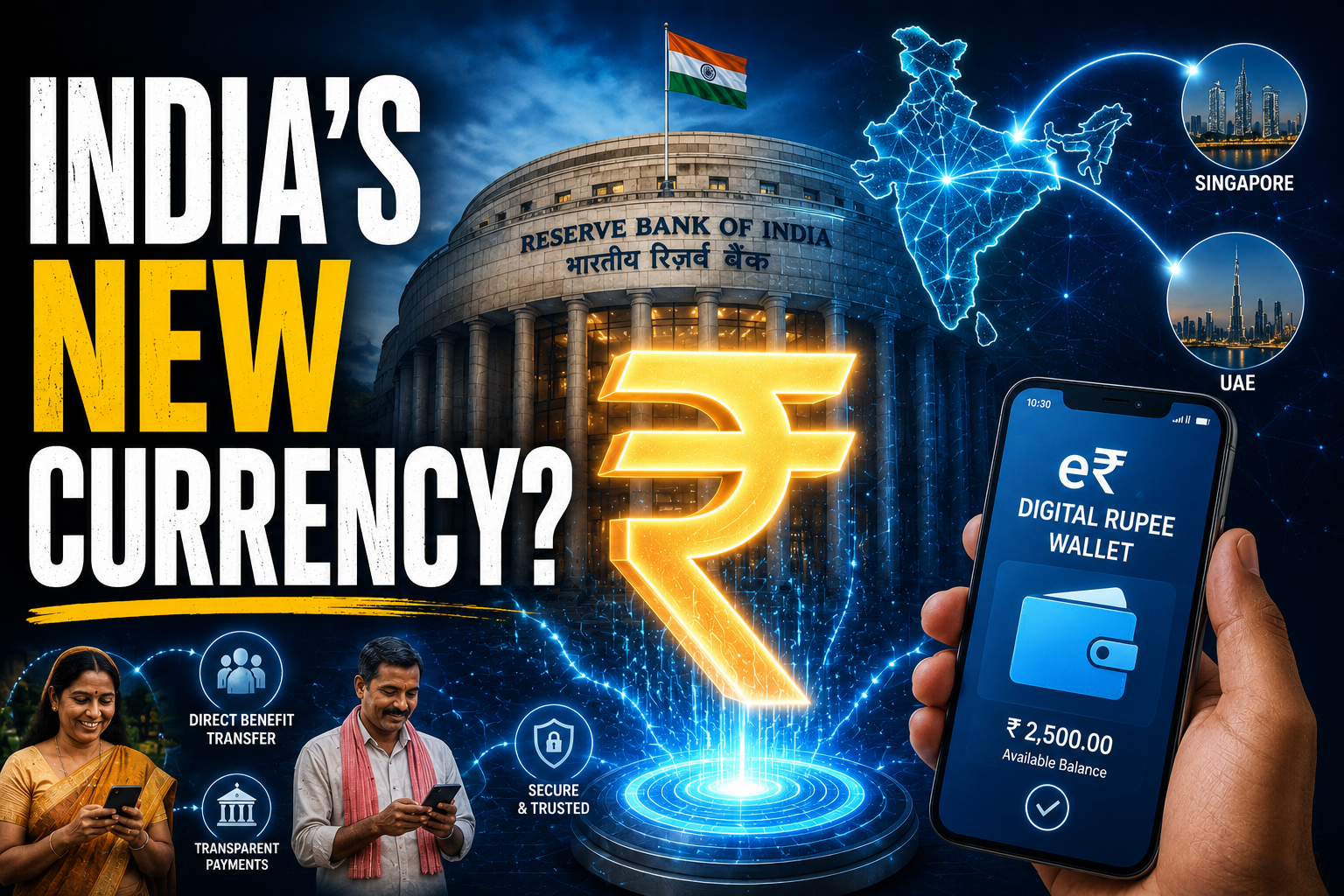
India’s digital rupee is entering a new phase. According to the Reserve Bank of India’s 2025-26 annual report, the central bank wants to expand the use of the digital rupee in welfare schemes and test it for cross-border payments. That is an important shift, because it suggests the RBI is no longer treating the e-rupee only as a pilot for retail payments. It is now being positioned as a tool for public spending, settlement efficiency and international payment experiments. At the same time, retail circulation has declined, which shows that adoption remains limited.
What Happened
The RBI said it conducted multiple welfare-linked CBDC pilots during the fiscal year, including in Gujarat, Puducherry and Chandigarh, where beneficiaries received food subsidies through the digital rupee. The central bank also said government agencies began pilots in direct benefit transfer schemes that used the programmable features of the CBDC to help track the use of public funds more closely. On the international side, the RBI said it has partnered with the Monetary Authority of Singapore and is in discussions with Singapore and the UAE for cross-border payment pilots.
The numbers, however, tell a more cautious story. Retail e-rupee circulation fell to ₹7.71 billion by March 31, 2026, from ₹10.16 billion a year earlier. That is not the profile of a currency that has caught on quickly with ordinary users. It suggests that while the RBI is expanding the project, public appetite is still limited.
Background
The digital rupee, or e-rupee, has been in pilot form since December 2022. Reuters reported that the RBI initially limited access mainly to banks, then began widening the pilot in 2024 by bringing in payment firms so that apps and wallets could be used more easily. By 2025, fintech platforms such as Cred and MobiKwik had joined the project, and Mintoak’s Digiledge acquisition became the first deal in India’s e-rupee-related ecosystem.
That background matters because it shows the RBI has been trying to solve a basic adoption problem for more than two years: how to make a central bank digital currency useful enough for people to keep using it. The answer has not yet been found in ordinary retail spending. Instead, the RBI appears to be shifting toward use cases where the digital rupee can do something conventional payment rails cannot do as easily, especially in targeted welfare delivery and controlled transfers. That is an inference from the RBI’s reported priorities, not a formal RBI statement.
Why It Matters
For citizens, the digital rupee could eventually make government transfers more precise and possibly easier to trace, especially if benefits are linked to specific spending purposes. For businesses and payment companies, it opens a new infrastructure layer that may sit alongside, rather than replace, existing digital payments. For the economy, it gives the RBI a live test bed for programmable money and cross-border settlement. For governance, it raises a bigger question: can a state-issued digital currency reduce leakage and improve delivery without becoming too intrusive?
There is also a practical tension here. India already has a mature digital payments culture, so the digital rupee does not succeed simply by existing. It has to be more useful than the alternatives. That is why the RBI’s newest push matters: if the e-rupee works better for subsidies, DBT and cross-border transfers than for ordinary shopping, then its real value may be institutional rather than consumer-facing. That would be a significant redefinition of the project. This is an analytical inference based on the RBI’s reported pilots and the decline in circulation.
Analysis
The most important takeaway is that the RBI seems to be moving away from the idea that the digital rupee must win as a mass-market replacement for cash. Instead, it is being framed as a government-grade payment layer for targeted use cases. That is a subtle but important pivot.
If that reading is correct, the digital rupee is less “India’s new wallet” and more “India’s new settlement rail.” Welfare transfers, subsidy tracking and cross-border pilots all point in that direction. In plain language: the RBI may be designing a currency that is easier for the state to use than for consumers to notice.
That approach has strengths. A programmable CBDC can, at least in theory, help governments direct funds more accurately. It can also support experiments in faster international settlement, which is one reason the RBI is talking to Singapore and the UAE. For policy makers, that is attractive because it puts India in a position to test a modern payment instrument without waiting for private platforms to create the entire system.
But the risks are equally clear. If people do not see a simple reason to use it, the digital rupee can remain a technically impressive but socially thin product. Low circulation is a warning sign, not a footnote. It suggests that convenience, trust and habit still belong to other payment systems in daily life. The RBI may therefore face a familiar public-policy problem: the state can build the infrastructure, but it cannot easily manufacture demand.
There is also a governance lesson. India’s digital-rupee project is becoming a test of whether public money can be made more traceable without making ordinary users feel watched. That balance will matter far more than the technology itself. If the e-rupee is linked to welfare, citizens will care about speed, reliability and privacy. If it is linked to cross-border payments, businesses will care about cost, compliance and settlement time. The RBI will have to satisfy both worlds if the project is to move beyond experimentation.
MARKET IMPACT
For banks, payment firms and fintech players, the digital rupee creates a new layer of competition and cooperation. Reuters reported that the RBI has already widened access beyond banks to payment firms and that companies such as Cred, MobiKwik and Mintoak have entered the space. That means the CBDC is no longer just a central-bank laboratory project; it is becoming a product ecosystem. Even so, the fall in circulation shows that commercial excitement has not yet translated into broad consumer demand.
Conclusion
India’s digital rupee is not a finished revolution. It is a still-evolving policy experiment with real ambition and visible limits. The RBI now appears to be betting on practical utility rather than mass hype: welfare delivery, controlled transfers and cross-border settlement. Whether that strategy succeeds will depend on whether the digital rupee can solve problems that existing payment systems cannot solve as efficiently. For now, the biggest story is not that the digital rupee exists. It is that the RBI is still trying to prove why it should matter.
With AI inputs