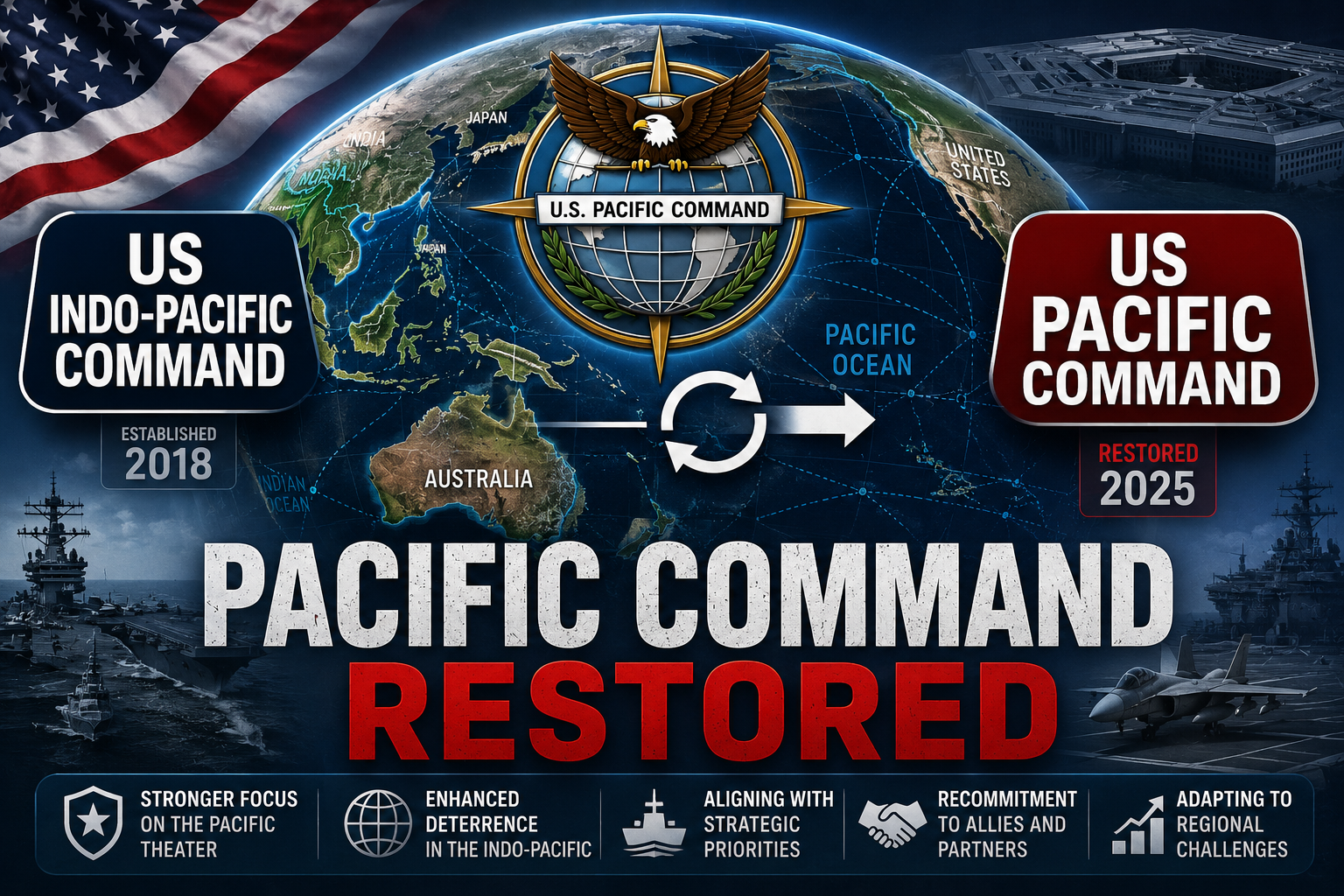
A seemingly small decision by the Pentagon has ignited a big debate about strategy in Asia. In June 2026, the U.S. military announced it would drop the “Indo” from the name of its Indo-Pacific Command – restoring the original “Pacific Command” title that had stood for decades. The move, effective immediately, reverses a 2018 change made under then-Defense Secretary Jim Mattis, who had renamed U.S. Pacific Command to “Indo-Pacific” Command as a nod to the Indian Ocean and India’s growing role. U.S. officials emphasize that this is a symbolic shift and that USPACOM’s responsibilities remain unchanged. But the decision has stirred questions in India and across the region: what does it signal about U.S. policy priorities? Does it downplay India’s importance in America’s Asian strategy? Or is it merely a restoration of tradition with no larger meaning? We break down the story, its context, and its significance.
What Happened
On June 16, 2026, U.S. Indo-Pacific Command announced that it will officially restore its name to U.S. Pacific Command. The change was posted on the command’s official channels and confirmed in a Pentagon statement. The U.S. Pacific Command (PACOM) was the original name of the organization dating back to 1947. Since 2018 it had been known as U.S. Indo-Pacific Command (USINDOPACOM). Under the new announcement, the command’s name and emblem will revert to “USPACOM.”
Pentagon officials stressed that the renaming will not alter the command’s mission, area of responsibility, or force structure. According to the press release, USPACOM’s “vast area of responsibility – spanning from the waters off the West Coast of the United States to the western border of India – remains exactly the same”. The department emphasized the command “will continue its fundamental mission and unwavering commitment to maintaining a free and open theater alongside regional allies and partners”. In short, no troops or operations are being shifted – only the name is changing.
News outlets reported the announcement widely. The Times of India noted that the U.S. “has not given any exact reason” for the renaming, but suggested recent strains in India-U.S. ties might be a factor. A Breaking Defense column observed the Pentagon simply posted a short notice on social media and issued a one-sentence statement; it called the move “restoring the original name to simply Pacific Command” after eight years. Both media cited the same official language: “Restoring the legacy USPACOM designation honors the command’s deep historical roots, fostering a sense of pride and collective spirit among all who serve in the Pacific,” the Pentagon said. In sum, U.S. officials are framing the change as an internal name restoration.
Background
To understand this shift, it’s essential to recall why “Indo-Pacific” was added in the first place. The U.S. Pacific Command (USPACOM) was established by President Harry Truman in January 1947 as the first permanent U.S. combatant command, covering Asia and the Pacific. It kept that name for over 70 years. In 2018, then-Defense Secretary Jim Mattis announced that U.S. Pacific Command would be renamed U.S. Indo-Pacific Command. Mattis said the change recognized “the increasing connectivity between the Indian and Pacific Oceans” and underscored India’s importance in the region. He explained that relationships with both Pacific and Indian Ocean partners were “critical to maintaining regional stability”.
That 2018 renaming was widely covered as a strategic signal. Reuters reported it was “a largely symbolic move underscoring the growing importance of India to the Pentagon”. Mattis and others tied the change to broader U.S. strategy, like the revival of the Quad (Australia, India, Japan, U.S.) and countering China’s maritime expansion. At the time, experts noted the renaming did not automatically bring more assets or new policies – it was meant to reflect a wider theatre of operations. One former U.S. official called it “ultimately a symbolic act” that would have limited impact without matching strategy changes.
In the years since, the Indo-Pacific concept became common in U.S. and allied policy. The Biden administration’s 2022 National Defense Strategy continued to emphasize the Indo-Pacific and India as a partner. U.S. war games and exercise names (e.g. Pacific Dragon, Tiger Tri-Services) also reflect the broader region. On the Indian side, New Delhi embraced its role in the “Indo-Pacific” vision, seeing it as recognition of India’s strategic stakes. For example, India’s Defence Secretary at the 2026 Shangri-La Dialogue spoke alongside USPACOM leaders (see image above) and India participated in major exercises.
Over the past year, however, U.S. defense leaders have also signaled a shift in tone. Newly appointed Defense Secretary Pete Hegseth has favored restoring historical names: his Pentagon has quietly reverted some Army bases to their pre-2020 names, and Hegseth even began informally calling the Pentagon the “Department of War”. In early June 2026, Hegseth praised India at the IISS Shangri-La Dialogue, calling it a “critical anchor” of regional security. Yet days later, the Pentagon rolled back the Indo-Pacific Command name. This change fits a pattern: some observers note Hegseth’s policy team is focused on traditional nomenclature and messaging.
A brief timeline of the command’s naming:
| Date | Event |
|---|---|
| Jan 1, 1947 | U.S. Pacific Command (USPACOM) established under President Truman. |
| May 30, 2018 | SecDef Jim Mattis renames it “U.S. Indo-Pacific Command” to include India. |
| June 16, 2026 | Pentagon announces Indo-Pacific Command will revert to “U.S. Pacific Command”. |
Why It Matters
On the surface, this change is mostly symbolic, but such signals can carry weight in geopolitics. For average citizens, the renaming itself has no direct effect: it doesn’t alter military deployments or budgets. But it can influence how people see the priorities of their government. In India, commentators have asked why Washington is dropping the reference to India at a time New Delhi is supposed to be a key partner. Some fear it could be read as a slight or a shift away from engagement in South Asia. In the U.S. and allied countries, the move may reinforce existing debates about how to define the “Pacific” and how much focus to give India versus China.
In governance and diplomacy, the name change comes at a sensitive moment. India and the U.S. have recently faced some tensions (for instance, over a maritime incident in which Indian sailors died under contested circumstances). Although the Pentagon insists that U.S. policy and cooperation with India will continue, some officials and experts in India are watching closely to see if the substance of U.S.-India ties changes behind the scenes. At the very least, it means Indian diplomats and strategists will need to calibrate their messaging – continuing strong ties while managing any domestic expectations that “Indo” being dropped signals a cooling relationship.
For the economy and businesses, the renaming has no immediate impact. Defense contracts, trade, and investment flows are driven by broader strategic and economic factors. US defense companies remain keen on Indian contracts, and joint exercises and technology deals are proceeding. If anything, the renaming might affect sectors like mapping, education, or tech that use the term “Indo-Pacific” in exercises or curriculums – they may need to adjust nomenclature. But these are minor ripples. The main importance is in the political message and alliance posture.
Society and the media have picked up on the story as an example of how political narratives evolve. In India, social media has reacted strongly, with some voices arguing it undermines India’s global standing. Others point out that India does not rely on symbolic names to define its partnerships; India has always pursued an “independent foreign policy” even as it deepens ties with many powers. In the U.S., the debate has been largely among specialists and journalists. The broader public is unlikely to notice, as long as security arrangements and trade remain stable. But for opinion-shapers in Delhi and Washington, the name change provides fodder for discussing the trajectory of U.S.-India relations and alliance diplomacy.
Analysis
Beyond the immediate facts, the name reversion reveals trends in how the U.S. uses language to signal strategy. In modern geopolitics, words matter. The 2018 switch to “Indo-Pacific” was an explicit signal that the U.S. was thinking in broader terms, including India as a critical “hinge” power between the two oceans. Reverting to “Pacific Command” could be read as shifting the emphasis back to the familiar Pacific theater.
One interpretation is that it reflects the priorities of Defense Secretary Hegseth’s team. Hegseth, a former military officer and media personality, has shown a preference for traditional names and symbolism. For example, he restored the name of the old “Army of Northern Virginia” at Fort Belvoir and joked about calling the Pentagon the “Department of War”. The PACOM renaming fits this pattern of rolling back changes made by predecessors. It suggests that under the current U.S. administration, some historical labels are being reinstated to reinforce institutional legacy and cohesion (“honoring deep historical roots” as the Pentagon put it).
However, the timing also invites strategic reading. Analyst Derek Grossman has argued that dropping “Indo” might indicate a “less hawky approach toward China” and greater engagement rather than containment. In other words, some see it as a clue that Washington may be recalibrating its strategy in Asia: perhaps focusing on diplomatic engagement rather than military signaling that heavily highlights India. Others caution against overinterpreting a name change. As Reuters cited a 2018 expert, such a renaming is “ultimately a symbolic act” with limited impact unless followed by concrete policy and investment. That perspective still holds: dropping “Indo” does not automatically mean troop levels or alliance commitments will change.
For India, the analysis centers on trust and self-reliance. Some Indian voices view the move with disappointment. Congress MP Shashi Tharoor asked on social media if it was “another nail in the coffin of the Quad”. Similarly, some observers on Indian Twitter called for India to invest more in its own defense and in the Andaman & Nicobar region’s infrastructure to ensure security independent of U.S. posture. Others have a more pragmatic view, noting that the U.S. already values India militarily. Indeed, as Defense Secretary Hegseth recently emphasized, “a powerful India acting in its own self-interest advances our shared goal of maintaining a balance of power across the region”. The U.S. government still lists India as a major strategic partner, and ongoing initiatives (like co-produced weapons and joint exercises) are proceeding.
One fresh angle is to consider the move in light of broader historical shifts in U.S. regional framing. In the late 20th century, Americans often said “Asia-Pacific”; then “Indo-Pacific” emerged as a more inclusive term. Geographically, replacing “Indo-Pacific” with “Pacific” reverses that trend. It is reminiscent of past debates (e.g., China objecting to the term “South China Sea” or Japan preferring “East Sea”). Here, the U.S. is essentially signaling that the Pacific theater name alone is sufficient. This may comfort some allies who worry that emphasizing “Indo-Pacific” could provoke Beijing, but it also risks making New Delhi question whether it is still fully anchored in U.S. strategy.
Another perspective is the domestic U.S. political context. Renaming a command is a top-down Pentagon decision, but it follows a pattern of policy reversals under a Trump-loyal administration with an unconventional agenda. Some U.S. political commentators have compared it to earlier “culture wars” over military base names or department labels. For instance, Breaking Defense noted that this renaming is among several that Secretary Hegseth has enacted, such as calling the Pentagon the “Department of War” in informal usage. These actions can be seen as part of a broader push to invoke historical legacy in defense policy. The risk, however, is that such changes become spectacles that distract from substance – much like how the “Department of War” comment became a media story.
The deeper strategic implication may come down to U.S. signaling. One interpretation is that Washington is subtly telling India it should invest more in its own security, rather than rely on U.S. umbrella. That could dovetail with calls for Indian strategic autonomy and stronger regional cooperation. On the other hand, it could simply be that the Pentagon wants to avoid confusion and use the simpler, original brand name. In any case, Indian policymakers will likely watch for whether this renaming presages any policy shifts – for example, whether future joint statements from the U.S. de-emphasize India, or if U.S. strategy documents revert to talking about “Asia-Pacific” more.
Name Options at a Glance
| Name Option | Used (Years) | Meaning / Implication |
|---|---|---|
| U.S. Pacific Command (USPACOM) | 1947–2018; 2026–present | Original title; emphasizes U.S. focus on the Pacific theater. Restoring tradition and legacy. |
| U.S. Indo-Pacific Command (USINDOPACOM) | 2018–2026 | Adopted by SecDef Mattis in 2018 to acknowledge the Indian Ocean and India’s role. Signaled expanded regional focus. |
Stakeholder Positions on the Rename
| Stakeholder | Response / Position |
|---|---|
| Pentagon / USA (Hegseth) | Officially: Supported returning to USPACOM to honor history. Emphasized mission and theater unchanged. Hegseth’s broader pattern: restoring traditional names. |
| India (Government) | No formal statement yet. India values partnership (Hegseth recently lauded India as a “critical anchor”) but will interpret the gesture cautiously. |
| India (Opposition/Analysts) | Mixed reactions: Some view it as downgrading India’s importance (e.g. “nail in coffin of Quad” by Shashi Tharoor). Others note substance remains unchanged and emphasize self-reliance. |
| China | No official comment. Likely welcomes move as U.S. downplaying “Indo-Pacific” concept, which China sees as aimed against it. |
| Other Allies (Japan, Australia, etc.) | Little public reaction. Focus is on continuity of U.S. commitments (mission unchanged) rather than the name itself. |
| Defense Analysts | Mostly see it as symbolic. Stress that real focus is on actions, not titles. Some say it may hint at strategy recalibration (e.g. less direct emphasis on India and China confrontation). |
Political Impact
Though the renaming decision was made by the Pentagon, it has political overtones. In the U.S., the administration that approved it has made similar branding moves (as noted) which some political commentators link to President Hegseth’s approach. There is no indication in Washington of a major policy review of the U.S.-India relationship; in fact, senior U.S. officials have been on record calling India a key partner. Domestically, the issue is too niche to become a partisan fight — even though it involves decisions made during the Trump-era transition, it’s framed as a continuity action by the current DoD.
In India, opposition politicians have already tried to turn it into a talking point. For example, Congress leader Rahul Gandhi has raised questions about “why the U.S. would drop India from a regional strategy name,” though the government has downplayed any diplomatic fallout. The ruling party (BJP) has highlighted that India’s defense and economic ties with the U.S. remain strong, citing Hegseth’s praise and ongoing joint ventures. At the end of the day, strategic decisions tend to be shared across governments in India, so both major parties will wait to see how things play out. If this name change becomes a campaign issue (e.g. in India’s state elections or U.S. Congress discussions), it will likely be in terms of broader trust in alliances rather than the rename itself.
Market Impact
The renaming of a military command has virtually no direct impact on financial markets or businesses. Defense contractors and the aerospace sector are more influenced by budgets, procurement deals, and geopolitical tensions than by the name of a command. No stock moves or trades are expected from this news. However, some industries might update terminology: for instance, companies that produce maps, educational material, or software could need to change labels to reflect “Pacific Command” rather than “Indo-Pacific Command.” Over the long term, if the name change were accompanied by policy shifts (e.g., changes in force posture or alliances), it could indirectly affect defense spending decisions, but the Pentagon has said no such shifts are planned.
Conclusion
The U.S. decision to drop “Indo” and revert to “Pacific Command” is a classic case of strategic signaling. On paper, it returns a historic name and stirs nostalgia. In substance, it is a way for the current Pentagon leadership to project continuity of mission while subtly redefining narratives. For India, the move is a reminder that partnerships depend on concrete actions as much as labels. While some in India may worry about a perceived downgrade, the U.S. Department of Defense insists nothing has changed operationally.
The bigger question is what comes next. If this was simply an administrative rollback of a branding choice, then regional alliances like the Quad and India’s defense ties should continue unaffected. But if it reflects a shift in priorities, India and its partners will have to adjust. Indian policymakers might use this moment to bolster domestic capabilities and reassure citizens of India’s importance. American officials, meanwhile, will likely stress that India remains a “critical anchor” in U.S. strategy, even as they honor PACOM’s legacy.
The renaming episode underscores a broader lesson: in the digital age, even symbolic changes can spread quickly and shape perceptions. The true measure of policy is not a name on a plaque, but the depth of cooperation, resources committed, and mutual trust. As one analyst noted, names alone are “symbolic” unless backed by real strategy. For now, the U.S. and India appear to be navigating that balance. The coming weeks and months will reveal whether this shift in words was just a headline or the tip of a more substantive realignment.
With AI inputs