How Aadhaar, UPI and India Stack Turned a Developing Nation into a Global Digital Governance Case Study
Every country has roads.
Every country has power lines.
Every country has railways.
But very few countries have built digital infrastructure that functions like public infrastructure.
India did.
That may sound like an unusual claim in a country more often associated with software outsourcing than governance innovation. Yet over the past decade, India has quietly built one of the world’s most ambitious digital public infrastructure ecosystems—connecting identity, payments, documents and data-sharing systems at a scale that few nations have attempted.
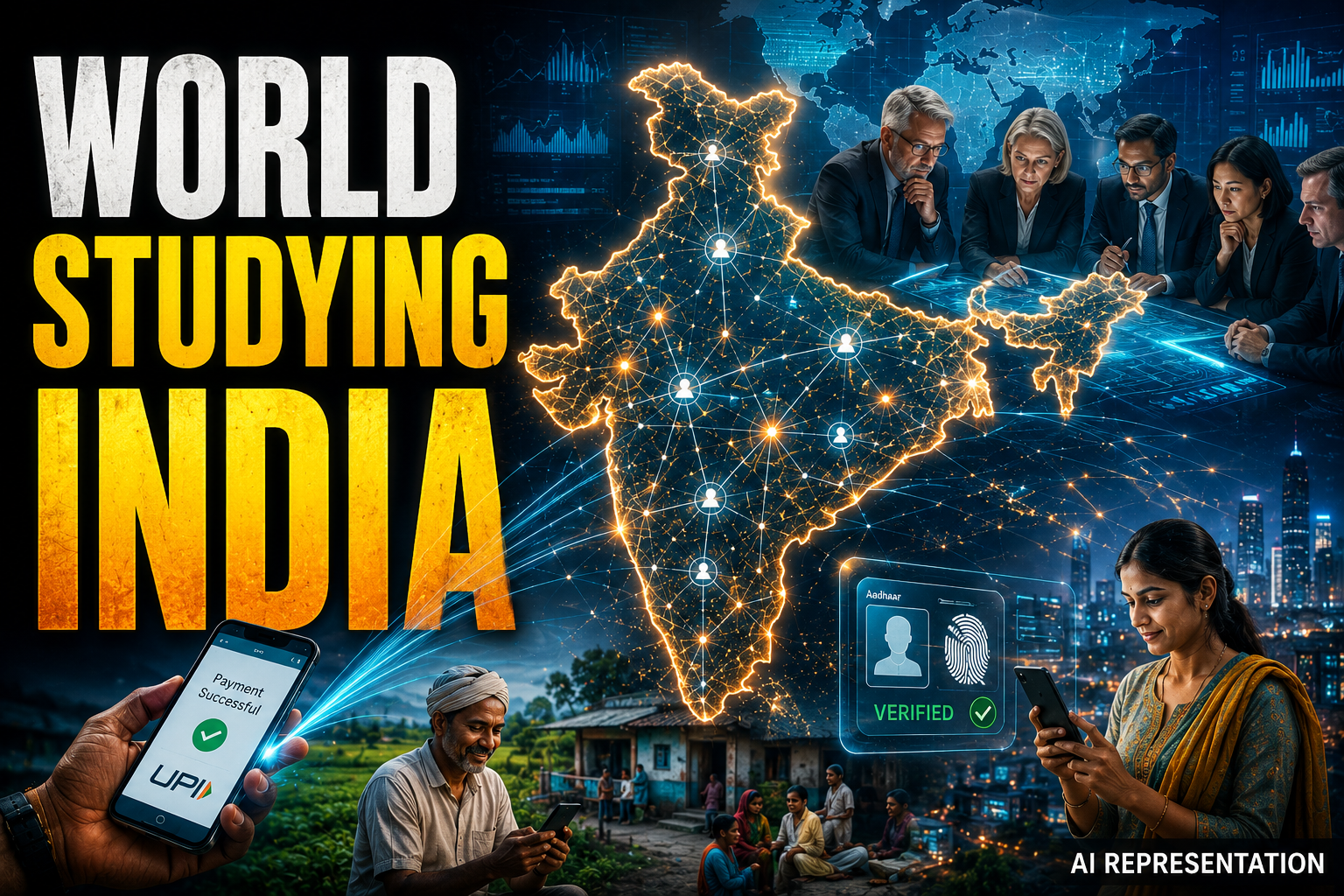
For most Indians, the system has become so routine that it is almost invisible. A fruit vendor receives a UPI payment. A student downloads a certificate from DigiLocker. A pensioner receives a government benefit directly into a bank account. A customer opens a financial account in minutes using digital verification. These everyday interactions are powered by a network of digital systems that together form what policymakers now call Digital Public Infrastructure, or DPI.
What makes India’s experience remarkable is not the existence of any one platform. Countries around the world have digital identity systems. Many have digital payment networks. Some have online government services. India’s innovation was to connect these pieces into a shared public architecture that could be used by governments, banks, startups and private companies alike.
International institutions have taken notice. The International Monetary Fund has described India’s digital public infrastructure as “world-class” and argued that it offers lessons for countries pursuing their own digital transformation journeys. During India’s G20 presidency, Digital Public Infrastructure emerged as a major policy theme, with discussions focused on how digital systems can support financial inclusion, productivity and public service delivery. According to G20 policy recommendations, DPI has the potential to accelerate inclusion and economic participation when supported by appropriate governance frameworks.
The story of India’s digital transformation is often told as a technology story. In reality, it is a governance story.
Background
To understand why India’s digital infrastructure has attracted international attention, it is important to understand the problem it was attempting to solve.
India’s challenge was never simply technological. It was administrative.
How do you verify the identity of more than a billion people?
How do you distribute welfare benefits across a vast and diverse country?
How do you expand financial services to populations that have historically remained outside the formal banking system?
How do you reduce paperwork, delays and leakages in public service delivery?
For decades, these questions existed at the heart of governance challenges not only in India but across much of the developing world.
The answer did not emerge through a single grand project. Instead, it evolved through a series of interconnected systems.
Aadhaar created a digital identity layer.
UPI created an interoperable payment layer.
DigiLocker enabled secure document storage and verification.
e-KYC simplified identity verification.
The Account Aggregator framework introduced consent-based data sharing.
Viewed individually, each system addressed a specific challenge. Viewed collectively, they formed a digital ecosystem capable of supporting everything from banking and welfare delivery to entrepreneurship and public services.
This ecosystem later became widely known as India Stack.
What Happened
The significance of India’s digital journey lies not in the technologies themselves but in how they interact.
Historically, governments built digital services as isolated projects. One department created one database. Another department created another. Information remained fragmented and difficult to share.
Digital Public Infrastructure takes a different approach.
Instead of building separate solutions for every problem, governments create foundational layers that can be reused repeatedly.
The IMF has compared digital public infrastructure to physical infrastructure such as roads and power networks. The value comes not only from the infrastructure itself but from the activities it enables across society and the economy.
This explains why UPI’s importance extends beyond digital payments.
The payment itself is only one transaction.
The larger impact lies in what that transaction enables: financial inclusion, digital commerce, small business participation, innovation and easier access to services.
Similarly, Aadhaar’s significance is not merely identification. Its broader role lies in enabling verification systems that support access to banking, government services and digital platforms.
Why It Matters
India’s digital infrastructure matters because it challenges an assumption that has shaped much of the modern technology era.
For decades, innovation typically flowed from wealthy countries to developing countries.
The internet emerged from the United States.
Many of the world’s largest software platforms emerged from North America and Europe.
Developing nations often adapted these innovations to local needs.
Digital Public Infrastructure represents one of the rare instances in which a developing country has become a source of institutional innovation that other governments are actively studying.
The implications extend beyond technology.
For citizens, digital systems can reduce paperwork, waiting times and transaction costs.
For businesses, they can reduce onboarding costs and improve efficiency.
For governments, they can improve service delivery and administrative capacity.
For economies, they can create new opportunities for innovation and inclusion.
According to IMF research, India’s digital journey has supported financial inclusion, reduced identity verification costs and enabled new forms of digital economic activity. World Bank-backed G20 documents have similarly highlighted the role of digital infrastructure in expanding financial access and improving service delivery.
Analysis
The most important lesson from India’s experience is not technological sophistication.
It is institutional thinking.
India’s achievement was recognising that digital systems could be treated as infrastructure rather than products.
Consider the analogy of a highway.
The government builds the road.
Private businesses build logistics networks, factories, restaurants and commercial activity around it.
The economic value of the road far exceeds the cost of construction because it enables countless other activities.
Digital Public Infrastructure follows the same logic.
The state provides foundational digital rails.
Entrepreneurs, banks, startups and service providers build services on top of them.
This approach lowers barriers to entry and allows innovation to occur at scale.
That is why many economists increasingly view DPI as an infrastructure question rather than a software question.
The deeper significance is that infrastructure shapes possibilities.
Roads determine how people move.
Power grids determine how economies function.
Digital infrastructure increasingly determines how citizens interact with institutions.
India’s experiment suggests that digital infrastructure may become as fundamental to economic development in the twenty-first century as roads and electricity were in the twentieth.
The Global Dimension
Perhaps the clearest indication of India’s influence is the growing international interest in its model.
Digital Public Infrastructure became a major theme during India’s G20 presidency, with policy discussions focused on how countries could leverage DPI to improve inclusion and productivity.
International institutions have increasingly framed DPI as a development tool rather than merely a technology initiative. IMF publications have argued that digital identity systems, payment networks and data-sharing frameworks can function as shared infrastructure supporting economic activity and public service delivery.
Reports published in 2026 indicated that India had entered cooperation arrangements with more than twenty countries interested in components of its digital infrastructure ecosystem.
Not every country will replicate India’s approach. Different societies have different laws, institutions and priorities.
But the fact that governments are examining the model at all marks a significant shift.
For decades, India studied global governance models.
Now, parts of the world are studying India.
Challenges and Criticism
No serious assessment of India’s digital infrastructure can ignore its challenges.
Questions regarding privacy, cybersecurity, data protection and governance remain central to discussions surrounding digital systems.
Critics have argued that large-scale digital infrastructure must be accompanied by robust safeguards to prevent exclusion, misuse or unintended consequences.
Supporters counter that these challenges are not unique to India and are part of broader global debates surrounding digital governance.
Both perspectives point toward the same conclusion.
The next phase of India’s digital journey will be determined not merely by technological innovation but by how effectively institutions manage trust, accountability and citizen rights.
Conclusion
The most remarkable aspect of India’s digital transformation is not that it built Aadhaar.
It is not that it built UPI.
It is not even that it connected hundreds of millions of people to digital services.
The remarkable aspect is that India began treating digital systems as public infrastructure.
Whether Digital Public Infrastructure ultimately becomes a global template remains uncertain.
Whether every component succeeds will continue to be debated.
But one fact is increasingly difficult to ignore.
For much of modern history, India learned from the world’s institutions.
Today, in the field of Digital Public Infrastructure, the world is learning from India.
With AI inputs.