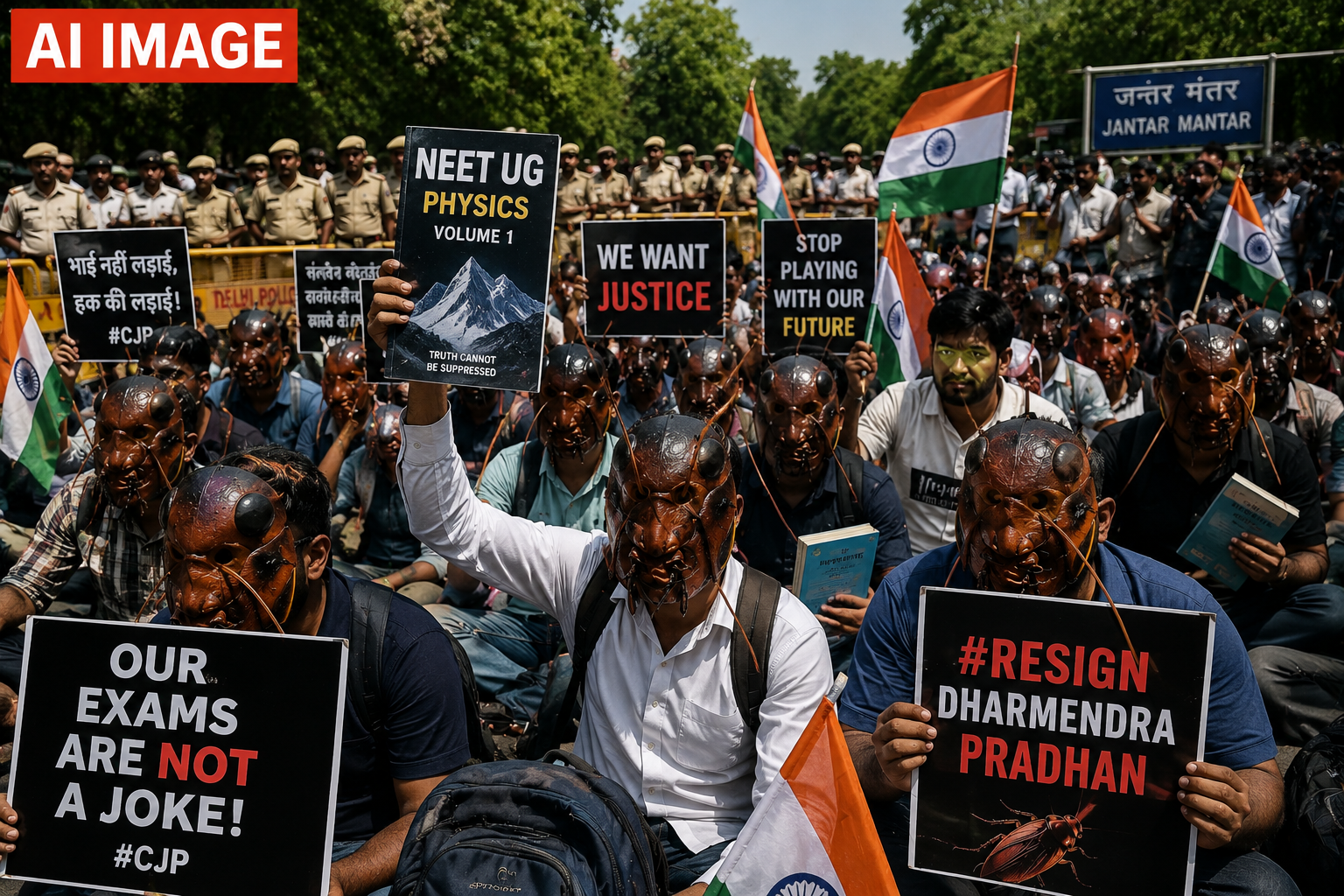
A movement that started as a social media phenomenon has now made its presence felt on the streets of the national capital.
The Cockroach Janta Party (CJP), a youth-led platform that gained rapid popularity online, organized its first major public protest at Delhi’s Jantar Mantar on June 6. While the immediate demand centered on alleged irregularities in examinations and recruitment processes, the gathering also highlighted broader concerns among young Indians regarding education, employment, and accountability.
What Happened
According to police officials and multiple media reports, hundreds of students, young professionals, and supporters assembled at Jantar Mantar after Delhi Police granted permission for the protest. Founder Abhijeet Dipke arrived in Delhi from the United States and addressed the gathering.
Participants carried books, Indian flags, flowers, and placards. Many wore symbolic cockroach masks, a reference adopted by the movement’s supporters. Protesters demanded accountability over alleged irregularities in examinations and recruitment processes and called for the resignation of Union Education Minister Dharmendra Pradhan.
Authorities deployed extensive security arrangements across Delhi, including around Jantar Mantar, the airport, and other sensitive locations. Police stated that several individuals were detained as a precautionary measure to prevent possible confrontations between groups. Officials later clarified that no FIR had been registered against the protesters.
Background
The Cockroach Janta Party emerged in recent weeks as a social media-driven youth movement. The group gained attention through online campaigns focused on alleged irregularities in examinations and recruitment systems, including concerns raised around competitive and entrance examinations.
The movement’s rapid growth has been unusual. What began as a satirical digital campaign evolved into a political and social pressure group capable of mobilizing supporters offline. Reports suggest the platform amassed a massive social media following within a short period, particularly among students and first-time voters.
The symbolic use of the term “cockroach” has become central to the movement’s identity, with supporters portraying it as a representation of resilience and survival.
Why It Matters
The significance of the protest extends beyond the specific demands raised at Jantar Mantar.
For students and job aspirants, examination credibility directly affects educational opportunities, careers, and economic mobility. Concerns about transparency in recruitment and testing systems can influence public confidence in institutions.
For governance, the protest highlights the growing importance of digital-first movements that can rapidly organize supporters and shape public discourse. Traditional political parties increasingly face competition from issue-based online campaigns capable of mobilizing large audiences.
For businesses and the economy, prolonged uncertainty around recruitment systems and educational pathways can affect workforce confidence and talent development. A generation that perceives barriers to opportunity may become increasingly politically active.
For society, the protest demonstrates how social media communities are evolving into real-world political and civic networks capable of organizing collective action.
Analysis
The most important story here is not the size of the protest but what it represents.
India has witnessed student movements before, from anti-corruption campaigns to protests around educational policies. However, the Cockroach Janta Party appears to represent a newer model of mobilization: decentralized, internet-native, meme-driven, and largely built outside traditional political structures.
Historically, youth protests in India often emerged through student unions, ideological organizations, or established political parties. The CJP’s rise suggests that social media ecosystems can now create independent political narratives with remarkable speed.
Another notable aspect is the movement’s focus on governance outcomes rather than identity-based issues. Much of the public messaging has revolved around examinations, recruitment, opportunities, and accountability. Whether this focus remains consistent over time may determine the movement’s long-term relevance.
The protest also serves as a reminder that examination-related controversies have become a recurring source of public dissatisfaction. Repeated allegations concerning recruitment and testing processes have created an environment where trust itself has become a political issue.
Perhaps the biggest question is whether the Cockroach Janta Party remains a protest movement or evolves into a broader political force. At present, it functions primarily as a pressure group rather than a formal political party. However, its ability to convert online engagement into street mobilization has already attracted national attention.
POLITICAL IMPACT
The protest introduces a new variable into India’s political landscape: digitally organized youth activism operating outside conventional party structures.
While it remains unclear whether the movement can sustain momentum, established political parties are likely to monitor its influence among students, first-time voters, and urban youth. The issues raised by the movement could become more prominent in future political debates, particularly around education, employment, and governance.
Conclusion
The Delhi protest marks a significant milestone for the Cockroach Janta Party.
What began as an online campaign has demonstrated an ability to organize supporters in the real world. While the immediate demands focus on alleged examination irregularities, the larger message emerging from Jantar Mantar is that many young Indians want greater transparency, accountability, and confidence in institutions that shape their futures.
Whether the movement becomes a lasting force or a momentary phenomenon will depend on its ability to move beyond symbolism and translate public frustration into sustained civic engagement.
TIMELINE OF EVENTS
07:30 AM – Abhijeet Dipke arrives in Delhi from the United States
Morning – Delhi Police confirms permission for the Jantar Mantar protest
Morning to Afternoon – Protesters gather at Jantar Mantar
Afternoon – Dipke addresses supporters and reiterates demands
Later in the Day – Police clarify that no FIR has been registered against protesters
With AI inputs