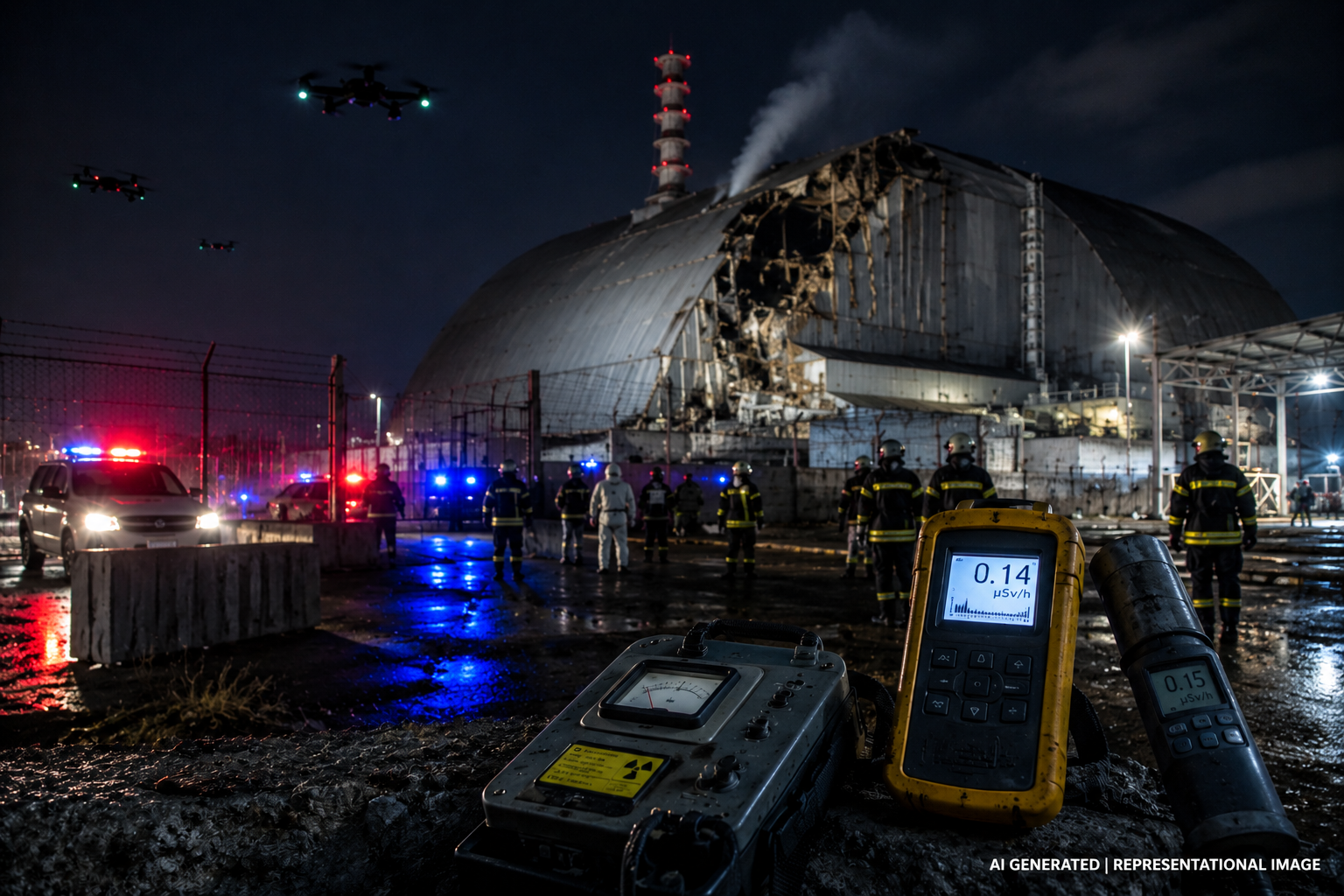
Nearly four decades after the world’s worst nuclear disaster, the name Chernobyl is once again making global headlines.
A Russian drone strike near the decommissioned Chernobyl nuclear power plant has sparked international concern over the safety of nuclear infrastructure in conflict zones. While authorities and international inspectors have reported no radiation leak, the incident has revived fears about the potential consequences of military operations around sensitive nuclear sites.
What Happened
According to Ukrainian officials, a Russian drone struck the Centralized Spent Nuclear Fuel Storage Facility located near the Chernobyl nuclear plant on June 7.
Ukraine’s government said the attack damaged a container reception building used as part of the facility’s operations. Officials reported that a fire broke out following the strike but was quickly contained.
The International Atomic Energy Agency (IAEA), whose experts were present at the site, confirmed that a fuel reception building suffered significant structural damage. However, the agency stated that no spent nuclear fuel was stored in the damaged section at the time of the attack.
Radiation monitoring systems at the site continued to report normal readings, and no radioactive contamination was detected.
Russia had not publicly commented on the incident at the time of publication.
Background
Chernobyl remains one of the most sensitive nuclear locations in the world.
The site was the location of the catastrophic 1986 reactor explosion that released radioactive material across large parts of Europe. Although the reactor was permanently shut down, the area continues to house nuclear waste management facilities and spent fuel storage infrastructure.
Since Russia’s invasion of Ukraine in 2022, international agencies have repeatedly warned about the risks posed by military operations near nuclear facilities.
The latest incident follows earlier reports of damage to structures associated with the Chernobyl exclusion zone during the ongoing conflict.
Why It Matters
The immediate danger may have been avoided, but the broader implications are significant.
For citizens across Europe, any military activity near nuclear sites raises concerns about environmental safety and public health. Even when radiation levels remain stable, repeated attacks increase the risk of accidents, miscalculations, or damage to critical systems.
For governments and regulators, the incident highlights the challenge of protecting nuclear infrastructure during armed conflict. International conventions emphasize the need to avoid military actions that could jeopardize nuclear safety.
Businesses and energy planners are also watching closely. Nuclear energy remains a key component of energy security strategies in several countries, and incidents like this can influence public perception, regulatory decisions, and investment patterns.
More broadly, the strike underscores how modern warfare increasingly threatens infrastructure with consequences that can extend far beyond the battlefield.
Analysis
The most important story may not be the damage itself, but what it reveals about the changing nature of conflict.
Modern wars are no longer limited to military targets. Energy facilities, communication networks, transport hubs, and critical infrastructure have become strategic pressure points.
The attack near Chernobyl demonstrates how even facilities that are no longer producing electricity can remain strategically significant because of the potential global consequences associated with them.
Another important lesson is the role of international monitoring agencies. The rapid confirmation from the IAEA that radiation levels remained normal helped prevent panic and misinformation. In an age where fears can spread faster than facts, transparent monitoring has become as important as physical security.
The incident also raises difficult questions for policymakers. Existing international frameworks were largely designed for a different era. As drone warfare becomes more common, governments may face increasing pressure to strengthen protections around nuclear sites and establish clearer consequences for actions that endanger nuclear safety.
Political leaders across Europe are likely to use the incident as further evidence that nuclear security can no longer be viewed separately from national security.
TIMELINE OF EVENTS
02:10 AM – Ukrainian officials say a drone struck the spent fuel storage facility.
Shortly After – Fire reported at the damaged building.
Emergency Response – Facility teams contain and extinguish the fire.
Same Day – IAEA inspectors assess the site.
Later Assessment – Radiation monitoring systems report normal levels.
International Reaction – Nuclear safety concerns raised by Ukrainian authorities and international observers.
Conclusion
The latest strike near Chernobyl did not trigger a radiation emergency, and international inspectors say there is no evidence of radioactive contamination.
However, the incident serves as a reminder that nuclear facilities remain vulnerable during modern conflicts. The immediate crisis may have been avoided, but the broader question remains unresolved: how can the world ensure the safety of nuclear infrastructure when war increasingly reaches critical civilian facilities?
With AI inputs