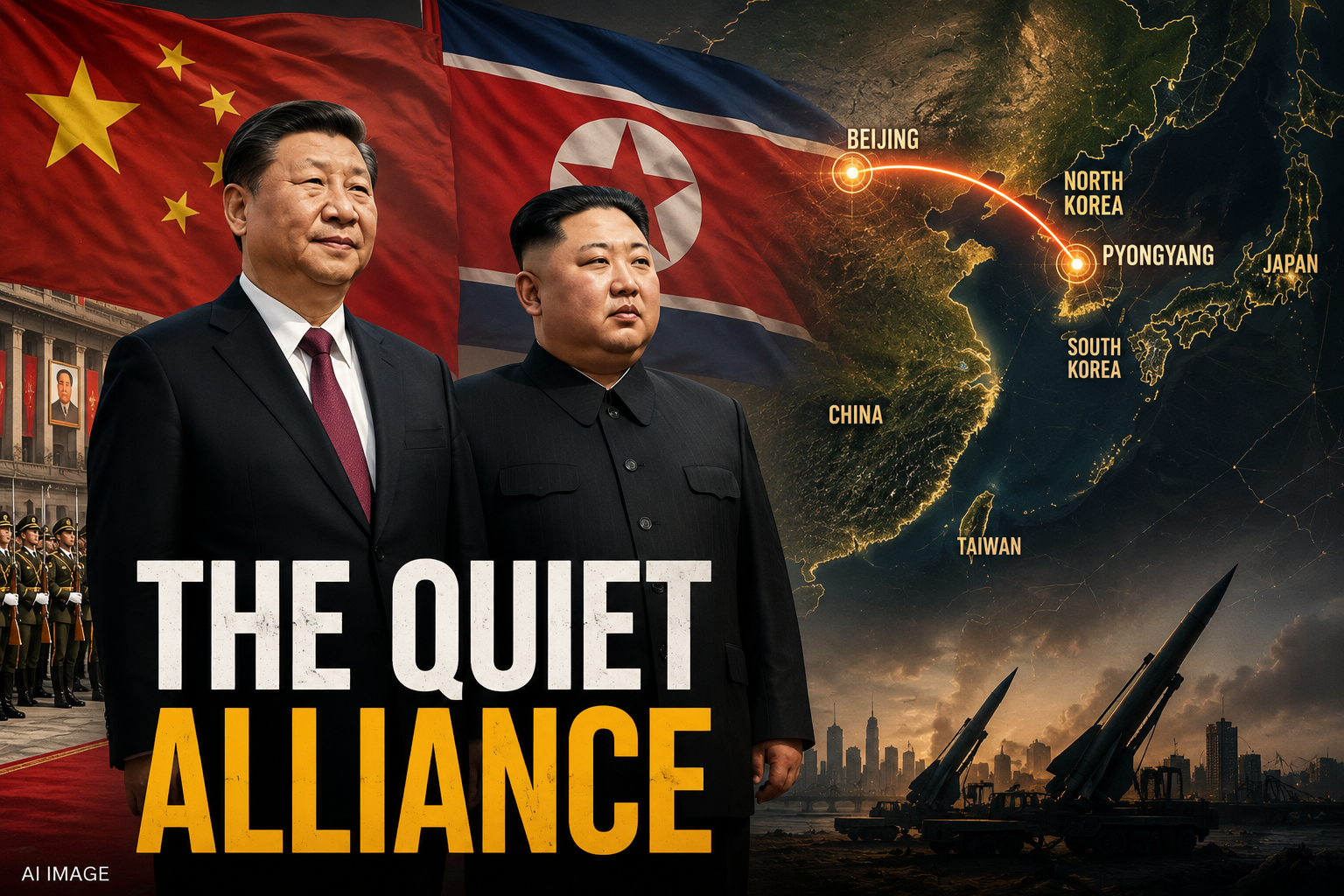
When Chinese President Xi Jinping arrived in North Korea this week, the images looked familiar: military ceremonies, smiling leaders, and declarations of friendship.
Yet beneath the symbolism lies a larger geopolitical story.
The visit comes at a time when global alliances are being reshaped by the war in Ukraine, rising tensions between China and the United States, and North Korea’s growing military confidence.
For observers across Asia, the question is not simply why Xi visited Pyongyang.
The bigger question is what this visit reveals about the future strategic landscape of the region.
What Happened
According to official announcements, Xi Jinping visited North Korea for a two-day trip, marking his first visit to the country in nearly seven years. Reports indicate that discussions focused on expanding cooperation in trade, agriculture, construction, and technology.
The visit also included symbolic events highlighting the long-standing relationship between the two countries, including commemorations linked to their historical alliance.
Notably, public statements surrounding the visit reportedly avoided detailed references to North Korea’s nuclear weapons program. Analysts cited by international media have interpreted this as a potentially significant diplomatic signal.
Background
China and North Korea have maintained a formal alliance dating back to the Korean War.
For decades, Beijing has been Pyongyang’s most important economic and diplomatic partner.
However, the relationship experienced periods of strain in recent years.
North Korea’s nuclear weapons development, international sanctions, and the COVID-19 pandemic disrupted trade and political engagement. Meanwhile, North Korean leader Kim Jong Un increasingly strengthened ties with Russia. Reports indicate that cooperation between Moscow and Pyongyang has expanded significantly since the Ukraine conflict began.
Against this backdrop, China appears eager to reassert its influence over a strategically important neighbour.
Why It Matters
This visit matters because North Korea occupies a uniquely important position in Asian geopolitics.
For China, North Korea acts as a geographic buffer between Chinese territory and United States military forces stationed in South Korea.
For North Korea, China remains a critical economic lifeline and diplomatic partner.
For regional governments, closer ties between Beijing and Pyongyang could affect future calculations on defence, trade, sanctions, and diplomacy.
The implications extend beyond the Korean Peninsula.
A stronger China-North Korea relationship could influence security debates across Japan, South Korea, Taiwan, and the broader Indo-Pacific region. It may also affect how Russia, China, and North Korea coordinate on strategic issues.
Analysis
The most important insight from Xi’s visit is that Asia is entering an era of more clearly defined geopolitical blocs.
For years, international attention focused primarily on the strategic competition between China and the United States.
However, the emerging picture is becoming more complex.
Russia and North Korea have moved closer together. China appears determined to preserve its influence in Pyongyang. Meanwhile, the United States continues to strengthen partnerships with Japan, South Korea, Australia, and other regional allies.
The result is a region increasingly shaped by competing networks of relationships rather than isolated bilateral disputes.
Another significant aspect is what was not discussed publicly.
The limited emphasis on North Korea’s nuclear program has raised questions among analysts about whether Beijing is adapting to a reality in which Pyongyang’s nuclear status is unlikely to disappear anytime soon. Reports suggest some experts view this as a pragmatic shift rather than a formal policy change.
Historically, major geopolitical transformations often become visible only after years of gradual change.
Xi’s visit may ultimately be remembered less as a diplomatic event and more as evidence of a broader strategic realignment already underway.
POLITICAL IMPACT
The visit strengthens China’s position as a key player in any future negotiations involving North Korea.
It also signals to regional powers that Beijing intends to remain deeply involved in shaping security developments on the Korean Peninsula.
Conclusion
Xi Jinping’s visit to North Korea was about far more than symbolism.
It demonstrated that China remains committed to maintaining influence in Pyongyang even as North Korea expands its relationships with other partners, particularly Russia.
The most important takeaway is not that China and North Korea are becoming allies again—they never stopped being partners.
The bigger story is that Asia’s strategic map is evolving, and the relationships being reinforced today could shape regional security for the next decade.
With AI inputs.