READ TIME: 4 Minutes
Behind every disaster statistic is a family story.
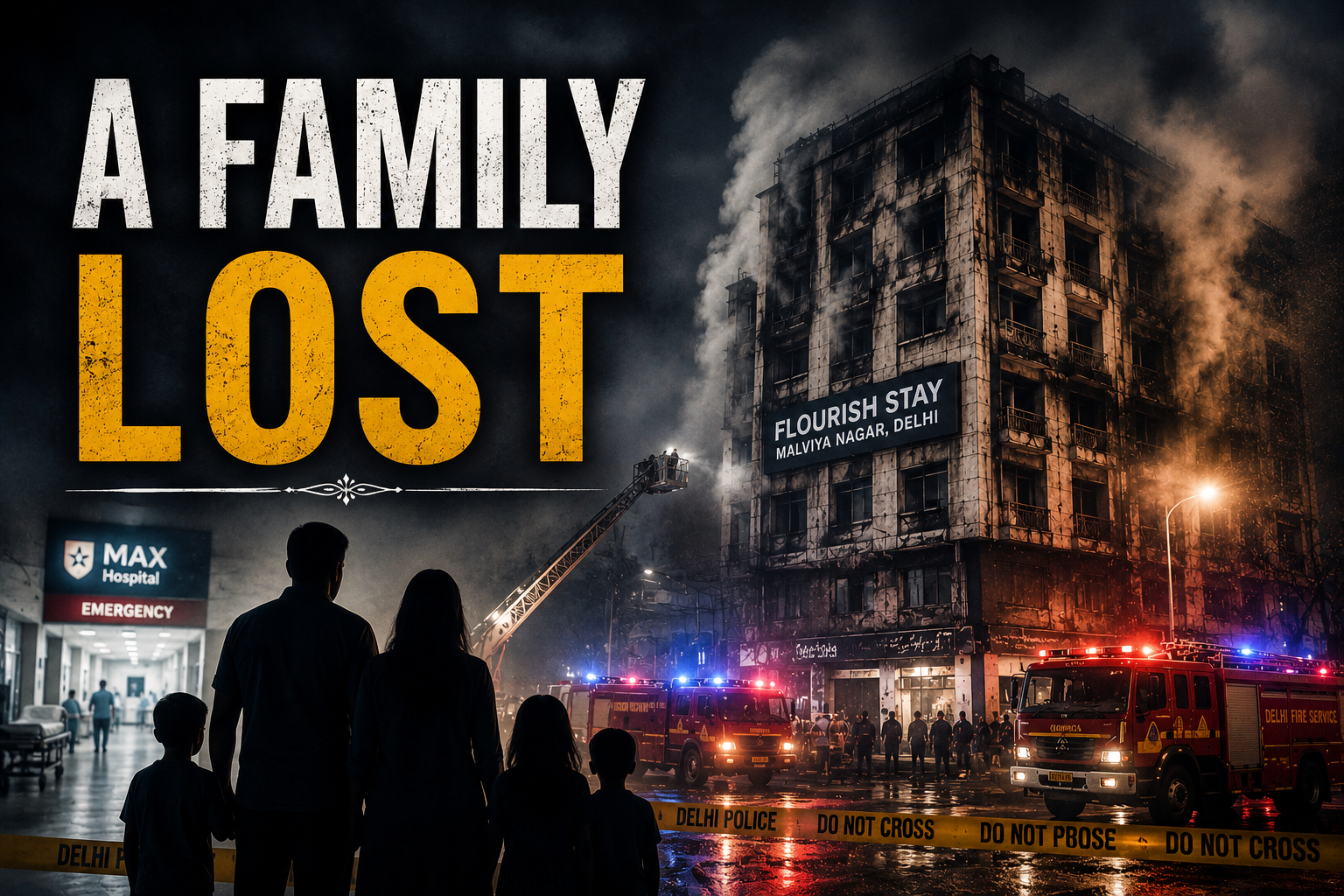
In Delhi’s Malviya Nagar fire tragedy, one family has come to symbolize the scale of the loss. While authorities reported 21 deaths in the blaze, the death of eight members of the Agarwal family has transformed a public tragedy into a deeply personal one for many following the incident.
The family had travelled to Delhi not for a holiday or celebration, but to be close to an elderly father undergoing medical treatment.
What Happened
According to reports, Vivek Agarwal, a chartered accountant from Gurugram, had travelled to Delhi along with his wife, two daughters and other relatives. The family booked rooms at the Flourish Stay guest house in Malviya Nagar so they could remain close to Max Hospital, where Vivek’s father was receiving treatment.
When the fire broke out, eight members of the family were trapped inside the building and lost their lives. Authorities later began DNA collection procedures to assist in the identification process.
Background
The fire at the Malviya Nagar property claimed 21 lives and injured dozens of others. Preliminary reports and statements from officials have raised questions regarding fire safety measures, building compliance and emergency exits at the establishment.
Investigators are examining whether violations contributed to the scale of the disaster. The inquiry remains ongoing.
Why It Matters
The Agarwal family’s story highlights a reality often lost in discussions about disasters: victims are not numbers. They are families with plans, responsibilities and relationships. The incident has also renewed concerns about safety standards in commercial accommodations, particularly in densely populated urban areas. For citizens, the tragedy raises questions about whether buildings advertised as safe places to stay are being adequately monitored. For policymakers and regulators, it serves as another reminder that enforcement failures can have irreversible consequences.
Analysis
The most striking aspect of the Agarwal story is its irony.
The family travelled to Delhi to support an elderly father battling health challenges. Yet the person they came to care for reportedly survived because he was in hospital, while eight family members staying nearby lost their lives.
This tragedy also exposes a recurring pattern seen after major urban disasters in India. Investigations often reveal questions about compliance, licensing and safety enforcement only after lives have already been lost.
The larger issue is not simply how the fire started. The bigger question is whether systems designed to prevent such disasters were functioning as intended before the tragedy occurred.
That question extends far beyond one building.
INVESTIGATION STATUS
Authorities have detained the property’s owner and launched an inquiry into the cause of the fire. Officials are examining allegations related to fire safety measures, occupancy limits and emergency evacuation infrastructure. The investigation remains ongoing, and final conclusions have not yet been released.
Conclusion
For many, the Delhi fire tragedy will be remembered as a disaster that claimed 21 lives.
For others, it may be remembered through the story of one family.
The Agarwals came to Delhi hoping to support a loved one through a medical crisis. Instead, their story has become a painful reminder that behind every headline and casualty figure are lives, relationships and futures that can disappear in a matter of minutes.
With AI inputs