Imagine a country where pet strollers begin outselling baby strollers.
Where kindergartens are converted into nursing homes.
Where wedding halls become funeral homes.
That is not a dystopian novel. It is South Korea.
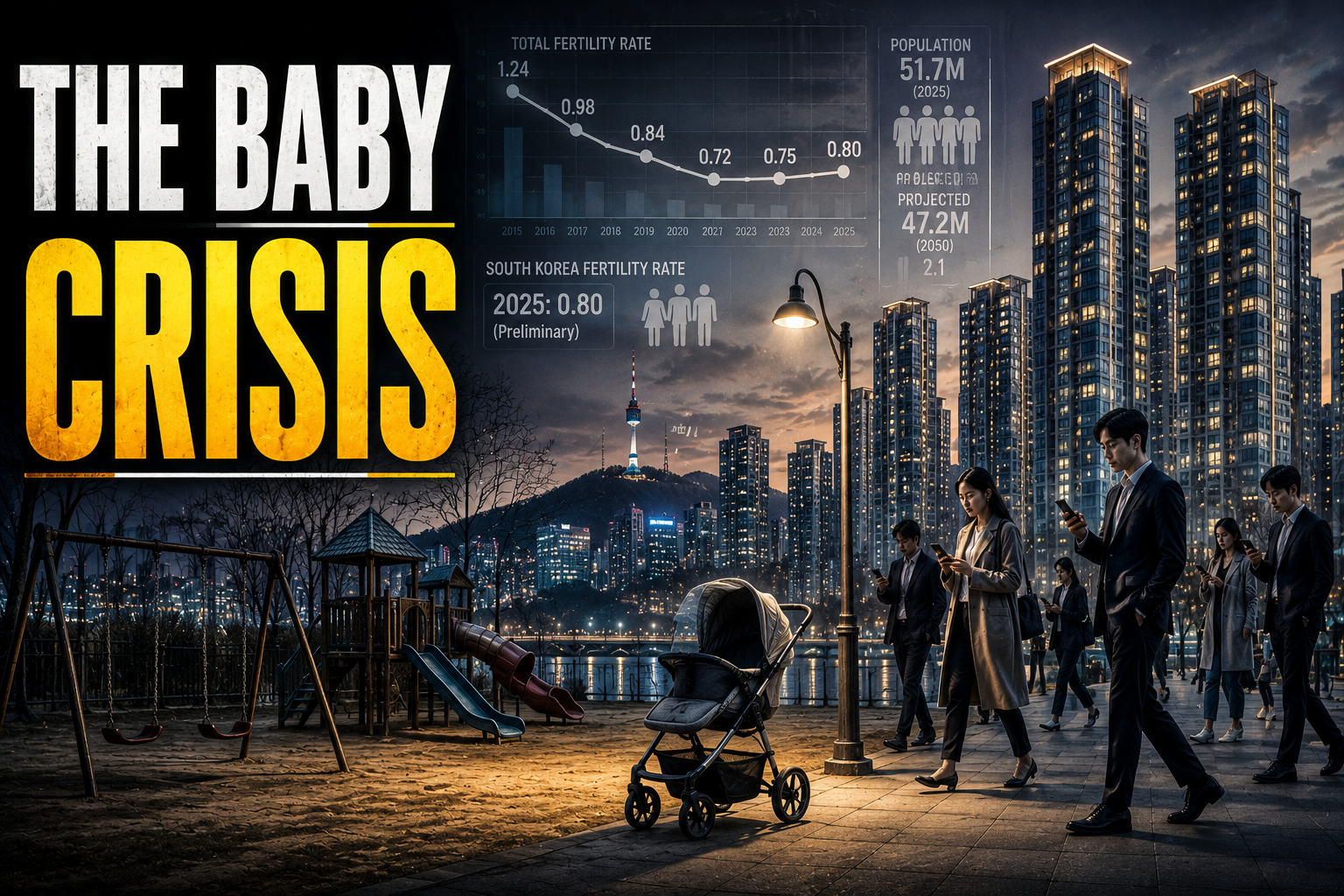
For more than a decade, South Korea has been confronting a demographic challenge so severe that economists, policymakers and demographers around the world have watched it with a mixture of concern and fascination. The country’s fertility rate—the average number of children a woman is expected to have during her lifetime—fell to 0.72 in 2023, the lowest recorded among OECD countries and far below the 2.1 births per woman generally required to maintain a stable population without immigration.
The implications were profound. Fewer births meant fewer future workers, fewer taxpayers, fewer students and a rapidly aging society. Population decline was no longer a future concern. It had already begun.
For years, the country’s response was simple: spend more money.
The government rolled out subsidies, childcare support, parental benefits, housing incentives and family-focused policies. Yet birth rates kept falling.
Now, something unexpected has happened.
The numbers have finally started moving upward.
What Happened
According to official South Korean statistics, the country’s fertility rate rose from 0.72 in 2023 to 0.75 in 2024. Preliminary government data released in 2026 showed a further increase to 0.80 in 2025.
That may sound insignificant.
It is not.
For a country that spent years setting new records for demographic decline, two consecutive years of improvement represent the first meaningful sign that the downward spiral may be slowing.
Births increased in 2024 and continued rising in 2025. Marriage rates—a leading indicator of future births in South Korea—also recorded substantial growth. Official data showed marriages rose nearly 15 percent in 2024 and another 8 percent in 2025.
Even Seoul, the capital and one of the most expensive cities in the country, recorded an increase in fertility rates, though it remains among the lowest in the nation.
Background
The crisis did not emerge overnight.
South Korea’s economic rise transformed the country from one of the poorest nations in Asia into one of the world’s most advanced economies within a few generations.
But prosperity brought new pressures.
Housing costs surged.
Education became intensely competitive.
Working hours remained among the longest in the developed world.
Young people increasingly delayed marriage and parenthood.
Women entered the workforce in greater numbers but often faced difficult choices between career progression and family life.
As these pressures accumulated, family formation slowed dramatically.
The result was a fertility collapse unlike anything seen in a major advanced economy. By 2023, South Korea’s fertility rate had fallen to approximately one-third of the level required to maintain a stable population.
Why It Matters
South Korea’s demographic challenge extends far beyond family life.
Population trends shape economies.
A shrinking workforce can limit economic growth.
An aging population increases demand for healthcare and pensions.
Governments face rising fiscal pressures while fewer workers contribute to the tax base.
Businesses struggle to recruit employees.
Schools lose students.
Entire regions risk gradual depopulation.
The OECD has warned that South Korea’s demographic trajectory represents one of the most significant long-term economic challenges facing the country.
The issue is also globally relevant.
Many advanced economies, including Japan, Italy, Germany and parts of Eastern Europe, face similar demographic pressures. South Korea is simply experiencing them more intensely and more rapidly than most others.
Analysis
The most important question is whether South Korea’s recent improvement represents a genuine turning point.
The honest answer is that nobody knows yet.
The rise from 0.72 to 0.80 is real and statistically significant. However, it still leaves South Korea with one of the lowest fertility rates in the world. A fertility rate of 0.80 remains dramatically below replacement level.
What makes the recent increase noteworthy is not the absolute number but the change in direction.
For years, policymakers were losing ground.
Now they appear to have stopped the decline.
Part of the improvement may be linked to post-pandemic normalization. Delayed marriages and births are now occurring. Rising marriage rates suggest more people are entering family life than in previous years. Government support measures may also be contributing to the shift.
Yet experts caution against declaring victory.
The structural issues that drove the crisis remain largely unresolved: expensive housing, demanding work cultures, education costs and persistent concerns about balancing careers with family life. These are not problems that can be solved through subsidies alone.
Perhaps the most important lesson is that demographic trends move slowly.
A fertility crisis that took decades to develop will not disappear in two years.
The Government’s Gamble
South Korea has committed enormous resources to addressing the issue.According to government plans, 88.5 trillion won (about $65 billion) was allocated in 2025 alone for programs addressing low fertility and population aging, including support for childbirth and families.
The scale of spending reflects the scale of concern. Officials increasingly view demographics not merely as a social issue but as an economic and national challenge.
The government’s long-term goal is to push fertility back toward 1.0 by the end of the decade and continue gradual improvement beyond that.
Whether that target is achievable remains uncertain.
Conclusion
For years, South Korea represented a warning about what happens when demographic decline becomes entrenched.
Today, it may represent something else.
A test case.
The recent rise in births and fertility rates suggests that the world’s deepest demographic crisis may be easing. But a recovery is not the same as a solution.
The numbers are improving, yet they remain historically low. The forces that pushed millions of young Koreans away from marriage and parenthood have not disappeared.
South Korea’s story is no longer about collapse.
It is about whether a country can reverse one.
And that question matters far beyond South Korea’s borders.
With AI inputs.