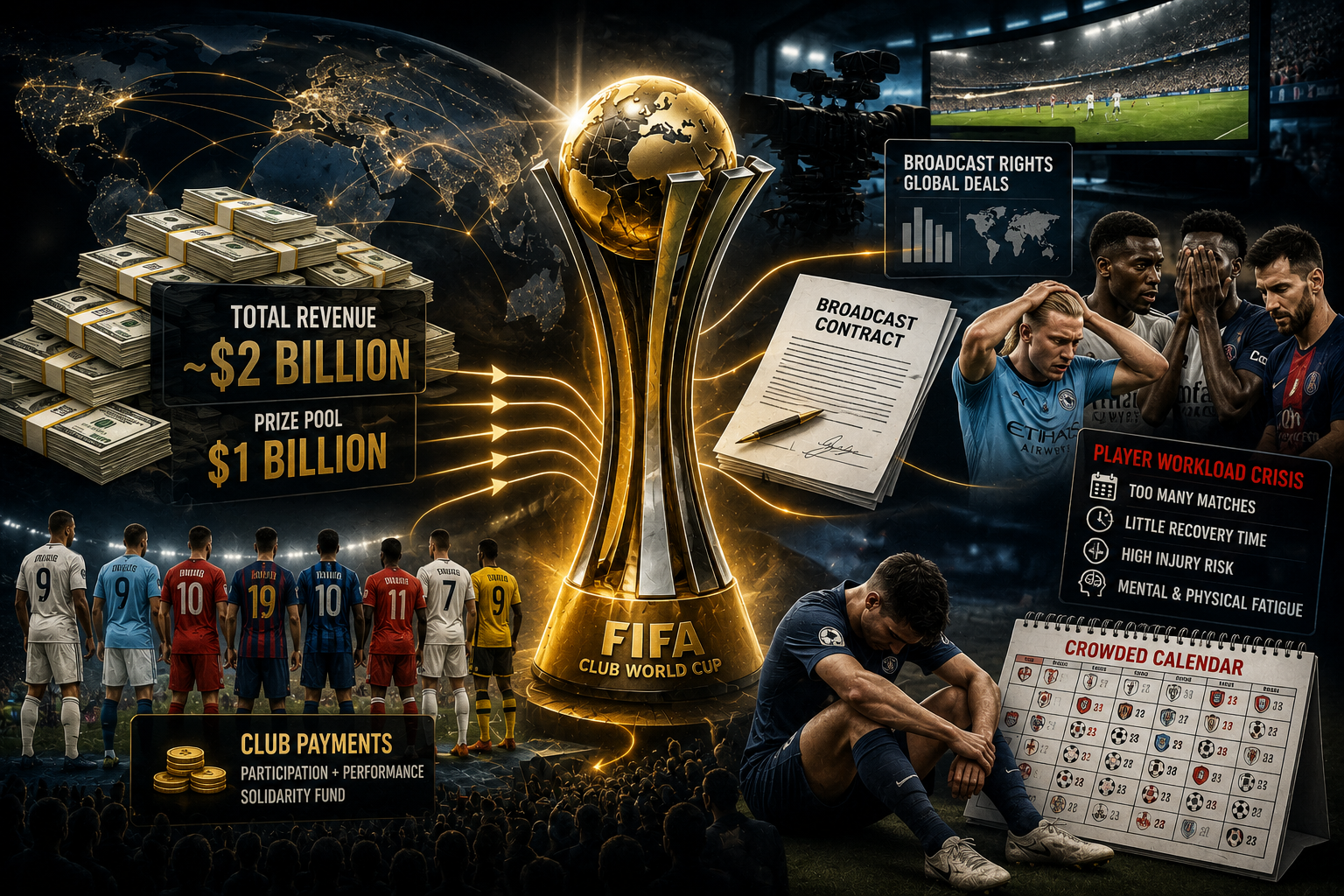
FIFA has turned the Club World Cup into a global business experiment. The 2025 edition was expanded to 32 teams and backed by a prize pool of $1 billion, while Reuters reported expected tournament revenues of around $2 billion. FIFA President Gianni Infantino said the money would be distributed to clubs and global club football, with FIFA’s reserves left untouched.
That is the public sales pitch: a richer, bigger, more global competition. But behind it is a harder question. Can world football keep adding events without breaking the players who make the game valuable? Clubs, leagues and players’ unions increasingly say no.
What Happened
FIFA’s new Club World Cup format became a 32-team tournament hosted in the United States from June 14 to July 13, 2025. Reuters reported that the winner could receive up to $125 million, with half the prize money tied to sporting performance and the other half tied to participation, sporting and commercial criteria. Reuters also reported that FIFA said all tournament revenues would be distributed through clubs and club football, not retained as profit.
The distribution is not equal. According to the published breakdown of the 2025 model, clubs from Europe could receive between about $12.81 million and $38.19 million in participation money depending on commercial and sporting ranking, while clubs from other confederations received fixed participation amounts, such as $15.21 million for South America and $9.55 million each for Asia, Africa, and North/Central America and the Caribbean. In addition, there was a $250 million solidarity pot for clubs worldwide.
Background
This tournament is not just about competition. It is about FIFA’s business model. Reuters reported that the organization expected about $2 billion in revenue from the event, making it one of the most important commercial properties in world football outside the World Cup itself. The DAZN broadcast deal and Saudi-linked commercial backing also underline how global capital has moved into the center of the sport’s biggest events.
That commercial push has a cost. The tournament arrived in a football calendar already crowded by domestic leagues, continental competitions and international windows. In 2024, FIFPRO and the World Leagues Forum filed a legal claim against FIFA, arguing that the expanded Club World Cup violated players’ rights by leaving no proper rest between seasons and by ignoring the growing burden on athletes.
Why It Matters
For clubs, the short answer is money. Participating means guaranteed payments, prize money and global exposure. For elite clubs, especially the European giants, the sums are especially large because the participation formula rewards sporting and commercial ranking. That is why the tournament is attractive to clubs even when they publicly complain about the calendar.
For fans, the tournament promises more high-profile matches in one place. For FIFA, it creates a new event that can be sold to broadcasters, sponsors and host markets. But for smaller leagues and players, the fear is that commercial gain is being extracted from a system that already asks too much of the same athletes.
Analysis
How much money is FIFA making?
The cleanest answer, based on Reuters, is that FIFA expected about $2 billion in tournament revenue from the 2025 Club World Cup, while the prize pool itself was $1 billion. FIFA’s public position is that this money is not being held back as profit: Infantino said all tournament revenue would be distributed to clubs, and FIFA’s reserves would remain untouched. So the event is a major revenue generator, but FIFA is presenting it as money flowing outward to clubs rather than inward to FIFA balance sheets.
Who gets paid?
The money is split in three main ways: participation payments to the 32 clubs, performance payments for results in the tournament, and solidarity payments to clubs worldwide. The champion can earn up to $125 million. Europe’s biggest clubs can receive far more than clubs from other regions because the participation formula includes sporting and commercial ranking. That is why the tournament is lucrative for the biggest brands and less lucrative for the rest of the football pyramid.
Why are clubs complaining?
Because they believe FIFA is expanding the event without respecting the limits of the football calendar. FIFPRO, the World Leagues Forum and leagues such as La Liga have argued that FIFA is prioritising commercial growth over player welfare and domestic competition integrity. Reuters reported that the players’ unions even took legal action over the expanded format, saying it left no proper rest between seasons and threatened players’ rights.
There is also a strategic complaint hidden inside the economic one. Clubs are not only worried about fatigue; they are worried about governance. The more FIFA expands its own competitions, the more it competes with domestic leagues and continental tournaments for time, attention and TV value. That makes the Club World Cup a power struggle as much as a sporting event.
Why are players worried about burnout?
Because the calendar is now asking top players to do too much with too little recovery. FIFPRO’s 2025 report said leading clubs such as PSG, Chelsea, Real Madrid and Manchester City gave players less than the recommended 28 days of off-season, and some had under two weeks of pre-season training. It also warned that some players face repeated summers without real breaks, along with huge travel loads and the mental strain that comes with constant competition.
That concern is not abstract. FIFPRO highlighted examples of players facing extreme workloads and long-distance travel, and the union warned that this creates both physical and psychological risk. The point is simple: football’s revenue model is increasingly built on more matches, but human bodies do not scale the same way broadcasting schedules do.
Conclusion
FIFA’s biggest gamble is not whether the Club World Cup can make money. It clearly can. The bigger question is whether football can keep monetizing more competitions without breaking the calendar, deepening the divide between rich clubs and everyone else, and pushing players into permanent exhaustion. Right now, FIFA is betting that the money is worth it. Clubs and players are warning that the bill may arrive later.
With AI inputs