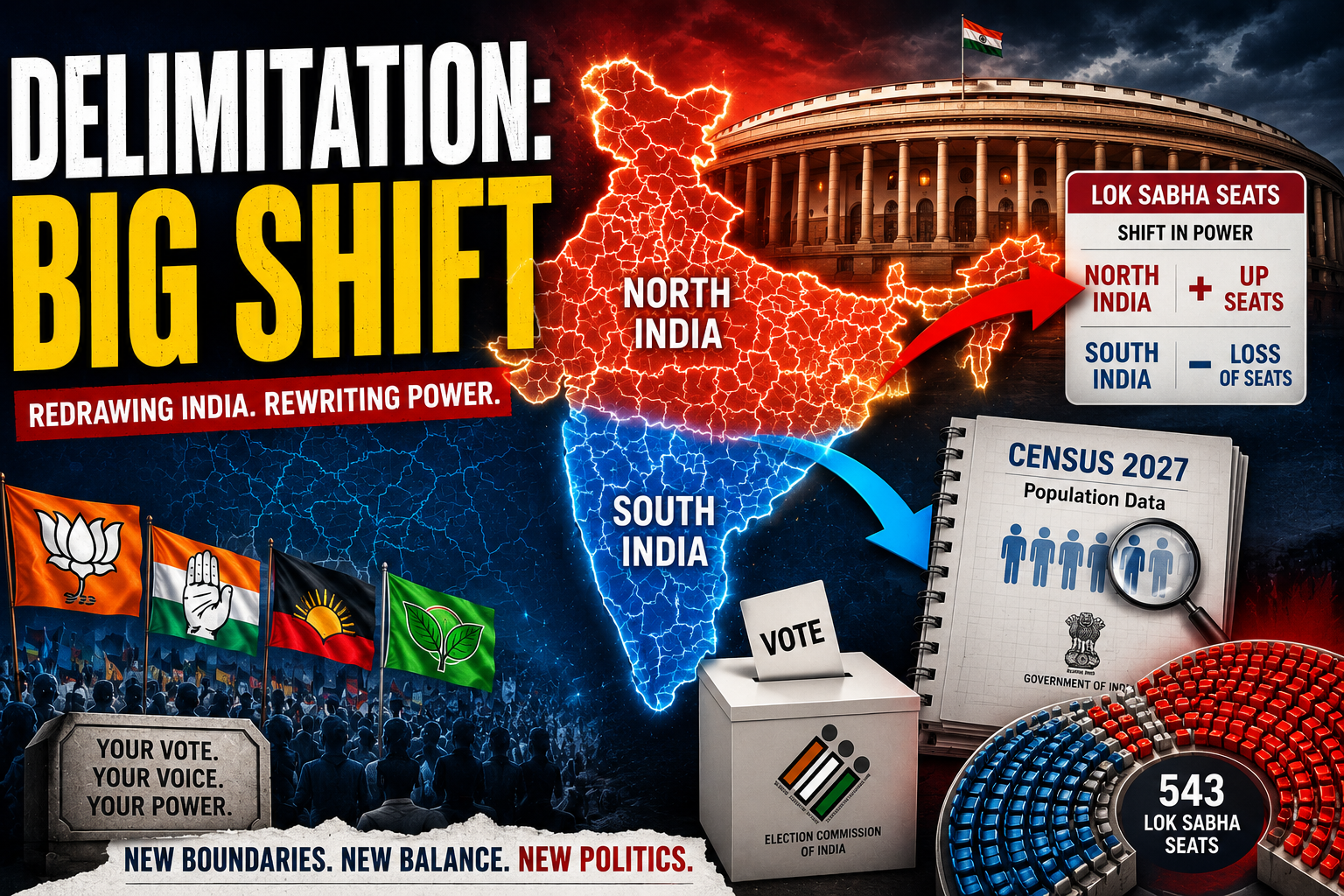
Delimitation is one of those constitutional words that sounds procedural but can alter power at the highest level. In India, it means redrawing parliamentary and assembly constituencies on the basis of population data. That sounds administrative. In reality, it can decide who speaks louder in Parliament, which states gain bargaining power, and whether the political map tilts toward the north or remains balanced across regions. Reuters reported in 2025 that southern states were already mobilising against a population-based redraw because they feared losing representation to more populous northern states.
What Happened
The latest phase of the debate intensified in 2025 and 2026. Southern leaders, led by Tamil Nadu Chief Minister M.K. Stalin, warned that delimitation based on fresh population data could reduce the political weight of states that had controlled population growth more successfully. Reuters reported that Stalin and other southern leaders argued this would punish better governance, while the BJP and Union Home Minister Amit Shah insisted no southern state would lose representation.
The issue became even more politically charged in April 2026, when the government tried to move a broader constitutional package linked to women’s reservation and delimitation. Reuters reported that the bill failed in the Lok Sabha by 298 votes to 230, a rare defeat for the Modi government. Opposition parties said the move could be used to manipulate future electoral balance, while the government said it was necessary to implement women’s reservation and reflect demographic change.
Background
India last fixed the total number of Lok Sabha seats at 543 for decades, even as the population changed sharply. Reuters noted that the current seat distribution remains tied to the older freeze, while the 2021 census was delayed and the next delimitation is expected after the first census following 2026. That is why the issue has become so explosive now: the constitutional clock is moving, but the political consensus is not.
The core fear in the south is simple. States such as Tamil Nadu, Kerala, Karnataka, Telangana and Andhra Pradesh have generally done better on fertility control and social indicators than many northern states. If a future redraw rewards population size alone, those states could end up with a smaller share of national power even though they contribute heavily to the economy. Reuters reported that southern states together make up about 30% of India’s GDP, which is one reason they see delimitation as more than a math exercise.
Why It Matters
For citizens, delimitation affects whether their region gets a stronger or weaker voice in national decision-making. For businesses, it can shift where policy attention, infrastructure spending, and welfare priorities go. For governance, it raises a basic democratic question: should political representation reflect population alone, or should it also account for the effort states made to control population growth and strengthen institutions? Reuters has reported that this question is now central to the north-south divide.
For political parties, delimitation is not neutral. It can reshape campaign strategies, coalition math, and the very value of regional alliances. A state that gains seats becomes more important in coalition politics. A state that loses relative influence may become more defensive, more assertive, and more willing to build regional fronts against the Centre. That is why delimitation is being treated as a federal flashpoint rather than just an electoral reform.
Analysis
The hidden truth about delimitation is that it is not only about where people live. It is about whose political choices get rewarded. If population becomes the dominant metric, then states that grew faster demographically gain greater influence in the national legislature. If historical freezes are extended too long, then states that controlled population may argue they are being penalized for following national policy goals. That tension sits at the heart of the current dispute.
This is why the issue cuts deeper than seat arithmetic. It touches the unfinished bargain of Indian federalism. The Centre wants a system that reflects current population. The south wants a system that does not turn good demographic performance into political loss. Both arguments carry democratic logic, which is exactly why delimitation is so hard to resolve. Reuters reported that southern leaders framed the issue as one of fairness and warned against being punished for controlling population, while the government argued that no southern state would lose seats.
There is also a broader political trend here. India’s next round of representation may not simply redistribute seats; it may redistribute confidence. If the southern states believe their voice is shrinking, they may demand new safeguards, compensation formulas, or constitutional protections. If populous northern states believe the freeze unfairly restrains their representation, they will push for a stronger claim to parliamentary weight. Either way, delimitation could sharpen regional identity politics for years. That is an inference from the current debate and the positions Reuters has reported.
The women’s reservation angle made the issue even more sensitive. In April 2026, the government tried to link delimitation to the rollout of women’s quota, but the proposal failed in the Lok Sabha. Reuters reported that the bill would have expanded the lower house substantially and was criticized by the opposition as a manipulation of the electoral map. That failure matters because it showed how quickly a technical constitutional reform can become a battle over legitimacy.
There is a historical comparison worth noting. India has frozen and adjusted representation before, but the present moment is different because the population gap between states, the economic gap between regions, and the political gap between Centre and opposition-led states are all moving at the same time. Delimitation is arriving in a climate where every institutional change is immediately read as a power play. That makes consensus much harder and the stakes much higher.
In that sense, delimitation may become one of the defining constitutional tests of the 2020s. If the Centre chooses a formula that is seen as fair, transparent and regionally balanced, it could stabilize India’s federal bargain. If not, it could deepen the north-south divide and turn representation itself into a permanent political grievance. Reuters has already shown that the debate has moved from abstract constitutional theory into active political mobilisation.
POLITICAL IMPACT
Delimitation could rewrite the logic of Indian politics. More seats in populous states would strengthen parties that already dominate those regions, while southern and some western states could fear reduced leverage in coalition negotiations. That would affect the future of alliance politics, Centre-state bargaining, and even the way national parties allocate campaign resources. Reuters reported that the controversy has already united opposition parties in the south against the government’s approach.
Conclusion
The biggest question is not whether delimitation will happen. It is how it will be designed, and who will feel protected by it. Done badly, it could harden regional resentment and reshape India’s political balance in favour of the most populous states. Done carefully, it could modernize representation without punishing states that performed well on population control. That is why delimitation is not just a technical reform. It is a test of whether India can redraw power without breaking trust.
With AI inputs