Artificial intelligence has become one of the defining technologies of the decade. Governments view it as a strategic asset, companies are investing billions into AI development, and consumers are increasingly using AI-powered tools in everyday life.
Yet behind the headlines about innovation and productivity lies a less discussed question: what resources are required to power the AI revolution?
Recent findings highlighted by the United Nations suggest that the environmental footprint of AI may be growing far faster than many policymakers, businesses, and users realize.
What Happened
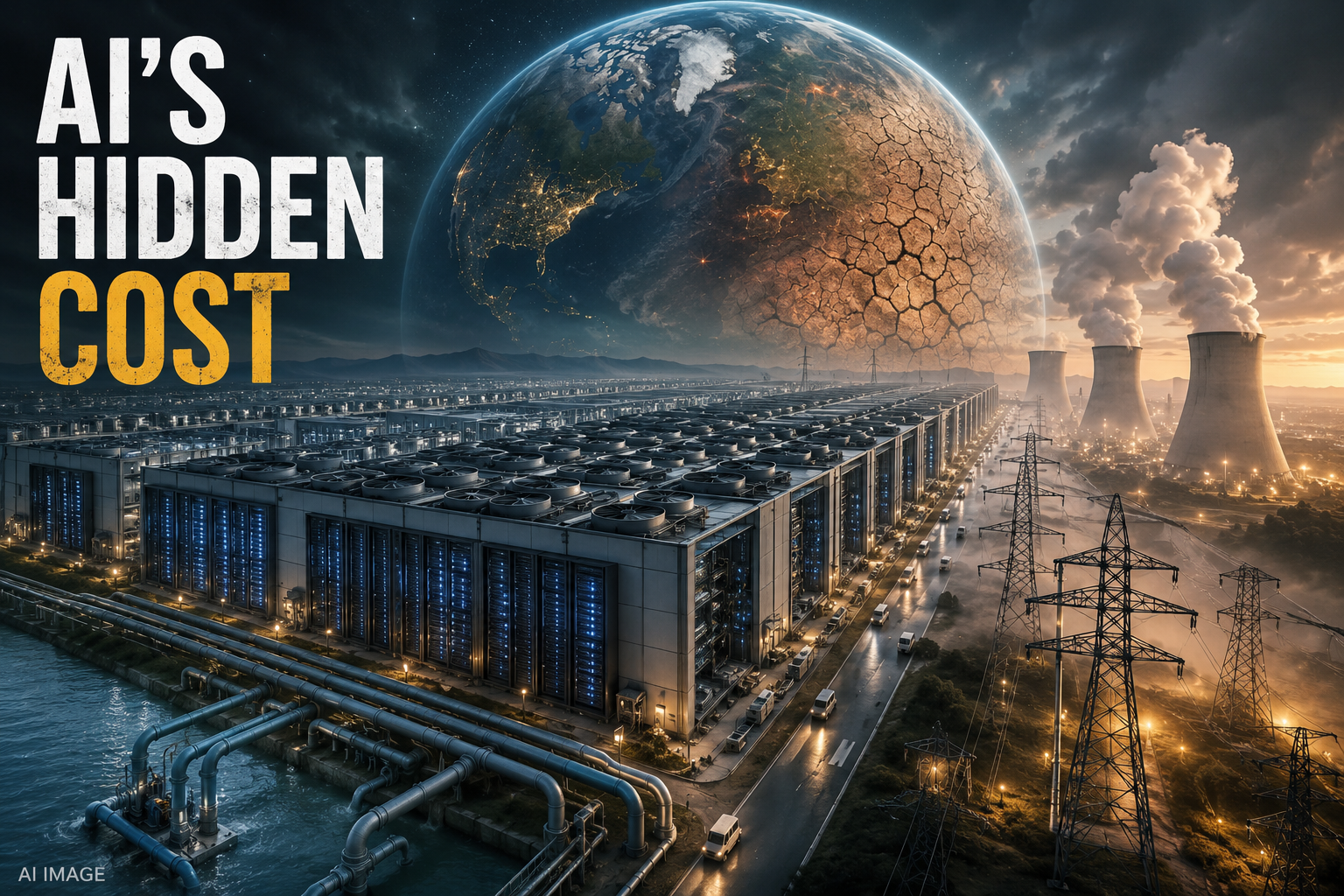
According to a report highlighted by the United Nations Office at Geneva, global data centres that power artificial intelligence could consume approximately 945 terawatt-hours of electricity annually by 2030. The report notes that this would represent nearly three times the combined annual electricity consumption of Pakistan, Bangladesh, and Nigeria.
The study also points to growing concerns surrounding water use and land requirements associated with AI infrastructure. Data centres require extensive cooling systems, while energy production itself often consumes large quantities of water.
Researchers cited by the UN estimate that AI-related water consumption could eventually approach levels comparable to the annual domestic needs of more than one billion people worldwide.
Background
The AI boom has triggered an unprecedented race among governments and technology companies.
Over the past few years, advances in large language models, generative AI systems, machine learning applications, and cloud computing have significantly increased demand for computing power.
Unlike traditional software, advanced AI systems require enormous computational resources during both training and deployment. These workloads are handled by large data centres containing thousands of specialized processors operating around the clock.
Historically, discussions around technology and climate have focused primarily on carbon emissions. However, researchers now argue that electricity consumption alone does not capture the full environmental impact of AI infrastructure.
Water usage, land occupation, supply chains, and energy sourcing all contribute to the broader sustainability equation.
Why It Matters
The implications extend far beyond the technology sector.
For citizens, growing electricity demand could place additional pressure on energy systems already facing rising consumption from urbanization and industrial growth.
For governments, AI introduces a new policy challenge: balancing technological competitiveness with environmental sustainability.
For businesses, future regulations may require greater transparency regarding resource consumption, energy sourcing, and environmental impact.
For society, the debate raises broader questions about how emerging technologies should be measured and governed. A technology that delivers economic productivity while placing strain on natural resources presents difficult policy trade-offs.
For developing countries, the issue is particularly important. Nations seeking to expand digital infrastructure may eventually face difficult choices regarding electricity allocation, water resources, and industrial priorities.
Analysis
The most important insight is that the future AI race may not be determined solely by software innovation.
It may increasingly become a competition for physical resources.
Much of the public conversation around artificial intelligence focuses on models, algorithms, and applications. However, the infrastructure supporting these systems relies on power grids, water systems, semiconductor manufacturing, rare materials, and land development.
This creates a new geopolitical dimension.
Countries with abundant energy supplies, stable infrastructure, and strong environmental management systems may gain a competitive advantage in attracting future AI investment.
The issue also challenges a common assumption that digital technologies are inherently resource-light. While AI products appear virtual to users, the physical infrastructure supporting them is substantial and growing rapidly.
Historically, industrial revolutions transformed societies through their demand for physical resources. The AI revolution may prove no different.
The key policy challenge is therefore not whether AI should continue to develop, but how governments, businesses, and technology providers can ensure that development remains sustainable.
Conclusion
Artificial intelligence is likely to remain one of the most transformative technologies of the twenty-first century.
However, the debate surrounding AI can no longer focus solely on innovation and economic opportunity.
As governments and businesses invest heavily in AI infrastructure, questions about electricity, water, land use, and sustainability are becoming increasingly important.
The next phase of the AI revolution may not simply be about building smarter machines. It may also be about managing the real-world resources that make those machines possible.
With AI inputs.