READ TIME: 8 Minutes
Introduction
The story of Bengal’s 2026 election is not merely about who won and who lost. It is also about how political organisation, strategy and voter sentiment combined to produce a result that many observers considered historic.
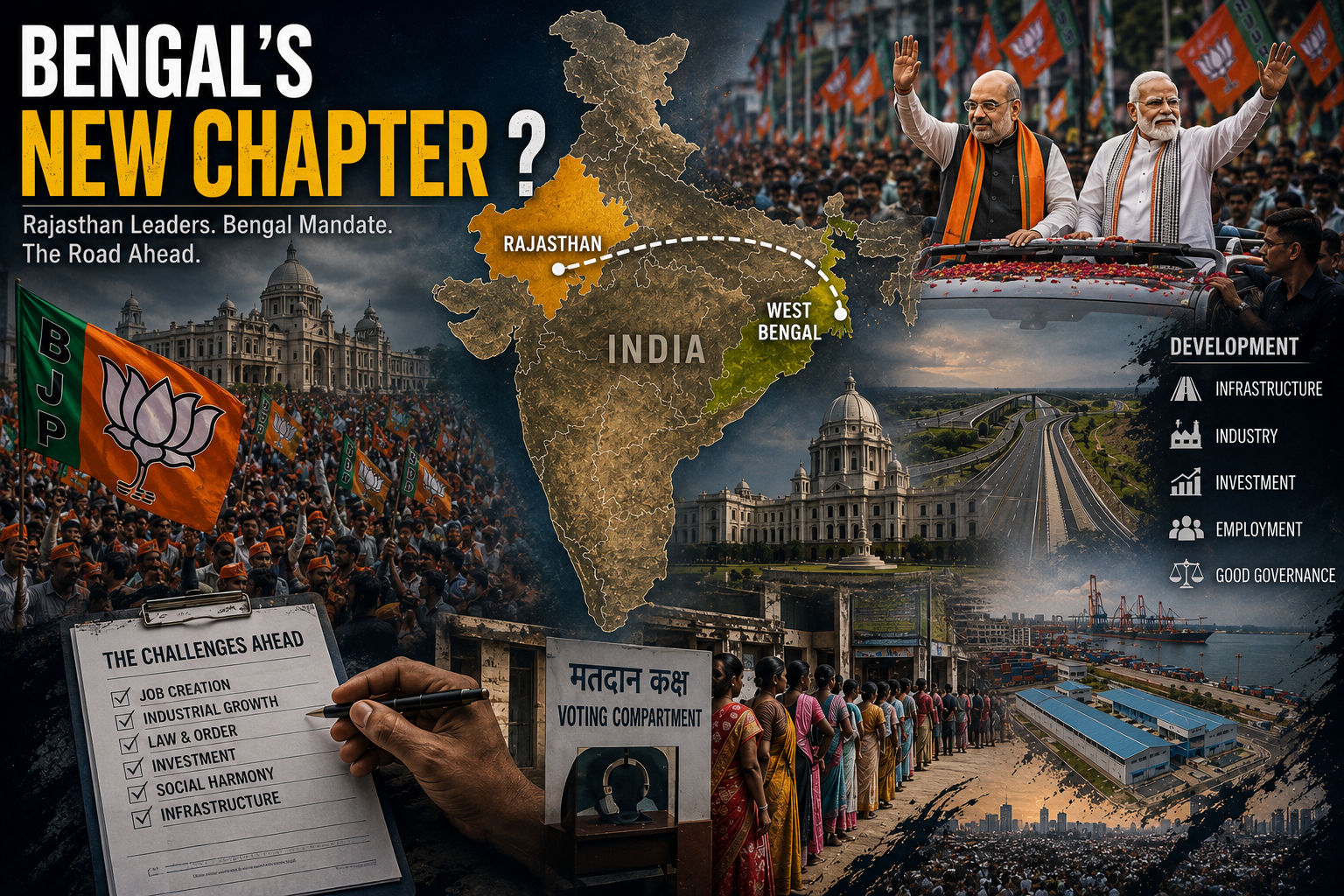
Among the lesser-discussed aspects of the campaign was the role played by several political leaders from Rajasthan, who were tasked with election management, booth operations, campaign planning and organisational coordination. Their involvement has drawn attention not only within political circles but also among those seeking to understand how modern elections are increasingly managed beyond state boundaries.
What Happened
The BJP secured a decisive victory in West Bengal after years of attempting to expand its footprint in the state. The election marked one of the most significant political shifts in Bengal in decades. Reports indicate that leaders including Bhupender Yadav, Sunil Bansal, Rajendra Rathore and several Rajasthan legislators were involved in campaign planning and execution.
According to party leaders, Rajasthan-based teams worked on booth management, voter outreach and constituency-level organisation, particularly in high-profile contests.
Background
For years, Bengal politics was largely dominated by the Trinamool Congress under Mamata Banerjee. However, the BJP steadily expanded its organisational presence through sustained campaigning, outreach programmes and strategic mobilisation efforts. Campaigns such as the Parivartan Yatra and extensive grassroots engagement were designed to build momentum before the election.
The election was fought around issues including employment, governance, welfare programmes, identity politics and development aspirations.
Key Developments
Several Rajasthan leaders emerged as important organisational figures during the campaign. Rajendra Rathore reportedly managed election efforts in Bhabanipur, while Bhupender Yadav and Sunil Bansal were credited with broader strategic responsibilities.
Political observers have noted that the campaign reflected a model increasingly used by national parties: deploying experienced leaders across states to strengthen local election machinery and messaging.
Political Impact
The result is significant beyond Bengal.
First, it demonstrates the growing nationalisation of state elections.
Second, it strengthens the perception that organisational capacity can be as important as charismatic leadership.
Third, it could elevate the stature of leaders who managed successful campaigns, including those from Rajasthan.
Why It Matters
For Citizens
The real test begins after the election. Voters will evaluate whether promises on jobs, infrastructure and public services translate into measurable outcomes.
For Bengal
The state’s long-standing challenges include industrial growth, employment generation, investment attraction and migration of skilled youth. These issues remain regardless of which party is in power.
For National Politics
A successful governance model in Bengal could strengthen the ruling party’s national narrative. Failure could quickly erode political goodwill.
Analysis
The more interesting question is not whether Bengal has entered a “new era.” Elections often create expectations that exceed what governments can realistically deliver.
A more useful question is whether the state can convert political change into institutional change.
History suggests that voters ultimately judge governments not by campaign slogans but by roads built, jobs created, investments attracted and law-and-order maintained.
If governance improves, supporters may view this election as a turning point.
If governance outcomes fall short, the election may be remembered as a political victory that failed to produce a corresponding developmental transformation.
The verdict, therefore, remains unfinished.
Questions That Remain
• Can the new administration attract significant private investment?
• Will job creation improve over the next five years?
• How will relations between the state and the Centre evolve?
• Can political polarisation be reduced?
• Will governance outcomes match electoral expectations?
What Happens Next
The next 12 to 24 months will likely determine whether the election becomes a genuine turning point or simply a transfer of political power.
Investors, businesses, citizens and political observers will closely watch indicators such as employment, industrial growth, infrastructure projects, law-and-order data and welfare delivery.
Frequently Asked Questions
Q1: Why are Rajasthan leaders being discussed in Bengal politics?
Several Rajasthan leaders were assigned campaign and organisational responsibilities during the Bengal election campaign and were later credited by party leaders for their contribution.
Q2: Does an election victory automatically lead to development?
No. Electoral success provides political authority, but development depends on governance, policy execution, investment and administrative efficiency.
Q3: What is the biggest challenge facing Bengal now?
Many analysts point to employment generation, industrial investment and economic growth as key long-term challenges.
Conclusion
Bengal’s election result may have changed the political map, but it has not yet changed the economic or social realities facing millions of citizens.
The role of Rajasthan’s political strategists may become part of election folklore. The more important story, however, is still being written.
The next chapter will not be decided in campaign war rooms. It will be decided in government offices, factories, classrooms and households across Bengal.
With AI inputs