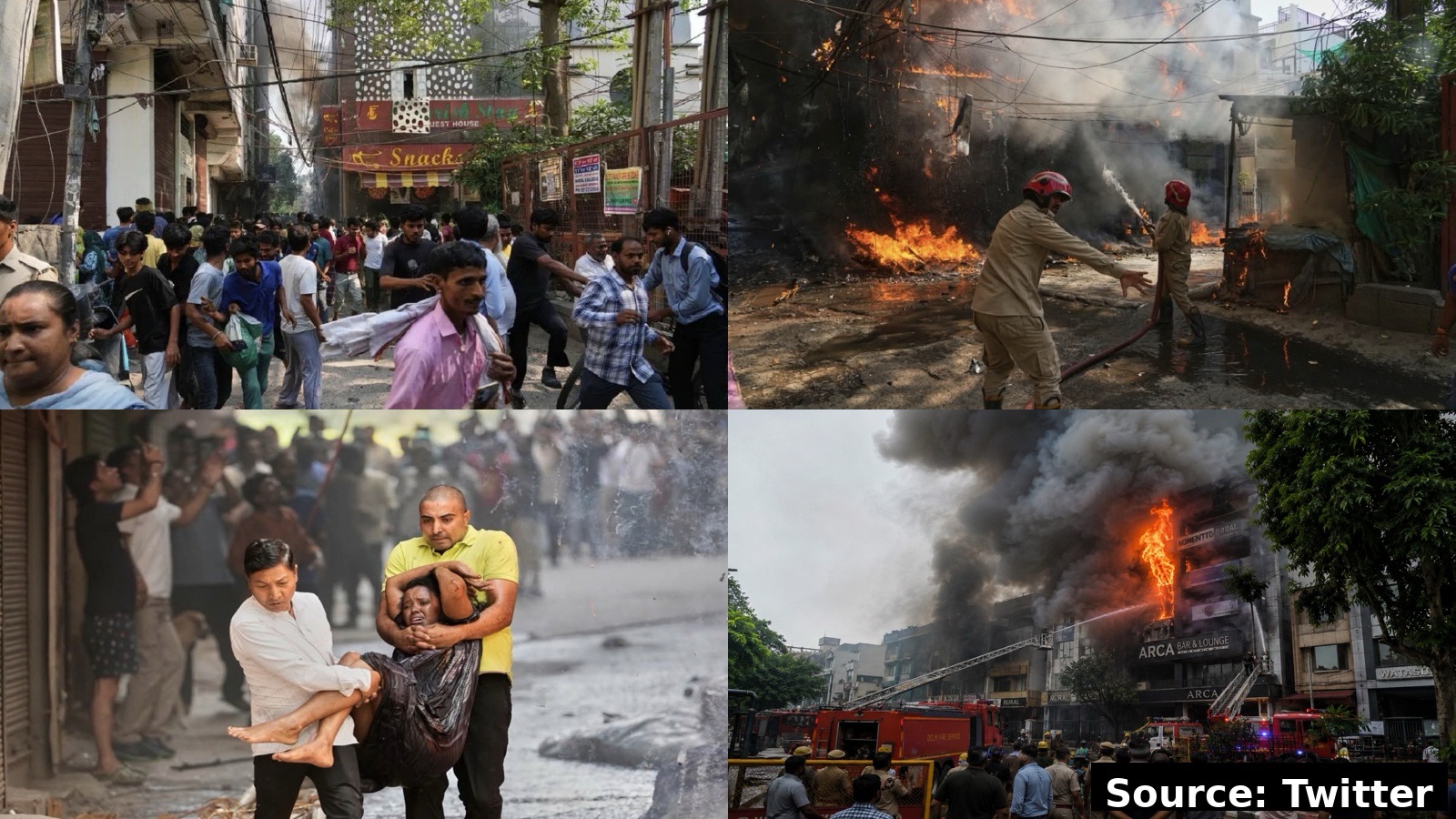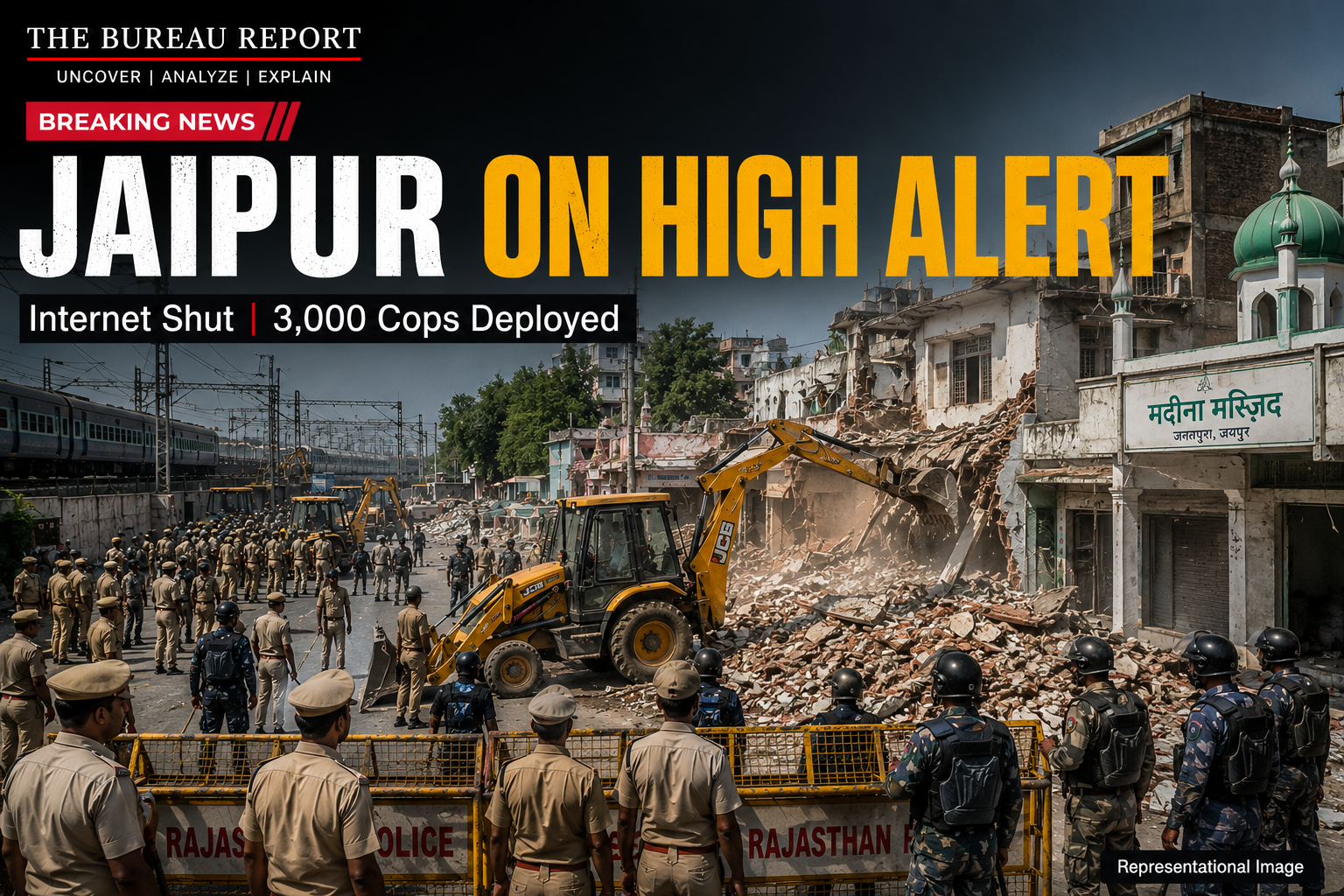
Jaipur remained on high alert on Monday as the administration launched a large-scale anti-encroachment operation linked to a long-pending road-widening project in the city’s Jagatpura area. To prevent any law-and-order issues, authorities suspended mobile internet services in parts of the city and deployed nearly 3,000 police personnel across sensitive locations.
The operation has attracted attention not only because of its scale but also because some of the structures identified for removal include religious sites located within the proposed road expansion corridor.
What Happened
According to officials, the Jaipur Development Authority (JDA) initiated demolition and clearance work near the Nandpuri Underpass in Jagatpura as part of a project to widen a road running parallel to the railway line.
Authorities said the road, which currently measures around 25–30 feet at several points, is planned to be expanded to approximately 80 feet to improve connectivity and ease congestion in the rapidly growing area.
As part of the exercise, officials stated that a mosque, two temples, a satsang hall and a mazar fall within the project’s right-of-way and are scheduled for removal. Authorities have said notices were issued earlier and stakeholders were given time to comply before direct action was initiated.
The administration suspended mobile internet services, social media access, bulk SMS and MMS services in Jaipur North and Jaipur East police districts. Voice calling services continued to remain operational.
Officials said the restrictions were imposed to prevent the spread of rumours and misinformation that could affect public order during the operation.
Background
The road expansion project has been under discussion for several years as Jaipur’s eastern suburbs, including Jagatpura and Malviya Nagar, have experienced rapid residential growth.
According to officials, hundreds of encroachments and unauthorized structures had gradually developed along portions of the proposed road corridor, creating bottlenecks and affecting traffic movement.
Earlier phases of the anti-encroachment campaign reportedly removed more than 100 structures. However, the presence of religious sites within the affected zone made the latest phase significantly more sensitive.
The administration cited infrastructure needs and urban planning requirements as the basis for the action, while some community representatives and political leaders raised concerns regarding the handling and timing of the demolitions.
Why It Matters
The Jaipur operation extends beyond a local demolition drive. It highlights a broader challenge faced by many Indian cities: how to execute long-delayed infrastructure projects when encroachments, including religious and community structures, have become part of the urban landscape.
For citizens, improved roads can reduce travel time and ease congestion in fast-growing neighbourhoods. For businesses, better connectivity can improve movement of goods and services. For city planners and administrators, such projects are often essential for future urban growth.
At the same time, actions involving places of worship can quickly become sensitive and require careful handling to maintain public trust and social harmony.
The internet suspension also revives an ongoing debate about whether communication restrictions are an effective and proportionate tool for maintaining public order during sensitive operations.
Analysis
The most important question is not whether a road should be widened, but why such projects frequently reach a stage where large-scale demolitions become necessary.
Across India, infrastructure projects often face years of delays due to legal disputes, encroachments, political considerations and administrative hesitation. As a result, when authorities finally move forward, the action tends to be larger, more disruptive and more controversial.
The Jaipur case illustrates a governance dilemma. Urban development requires enforcement of planning norms, yet delayed enforcement can make even legally sanctioned projects politically and socially difficult.
Another significant aspect is the administration’s reliance on preventive measures such as internet restrictions, heavy police deployment and drone surveillance. These measures suggest that authorities view information management and public perception as important components of modern law-and-order strategy.
The broader lesson is that cities cannot rely solely on demolition drives to solve planning challenges. Early enforcement, transparent communication, community consultation and long-term urban planning may reduce the need for such high-security operations in the future.
INVESTIGATION STATUS
The anti-encroachment operation is an administrative action and not a criminal investigation.
According to officials, the demolition drive is being carried out under existing planning and development regulations. Authorities continue to monitor the situation and have warned against the circulation of rumours or inflammatory content.
TIMELINE OF EVENTS
12:00 AM – Mobile internet restrictions come into effect in parts of Jaipur
Early Morning – Security deployment intensified across sensitive locations
06:00 AM – JDA teams begin anti-encroachment operations in Jagatpura
Morning – Bulldozer action starts along the proposed road-widening corridor
Throughout the Day – Police, administrative teams and drone surveillance monitor the situation
Conclusion
The Jaipur bulldozer action represents more than a local demolition drive. It reflects the difficult choices cities face as they attempt to modernize infrastructure while navigating legal, social and political sensitivities.
The immediate objective is road expansion and traffic improvement. The larger question is whether Indian cities can address urban planning challenges earlier and more effectively, before they evolve into high-security operations requiring internet shutdowns and thousands of police personnel.
With AI inputs